
Cortex 2.0: Grounding World Models in Real-World Industrial Deployment
- LM&RoVLM
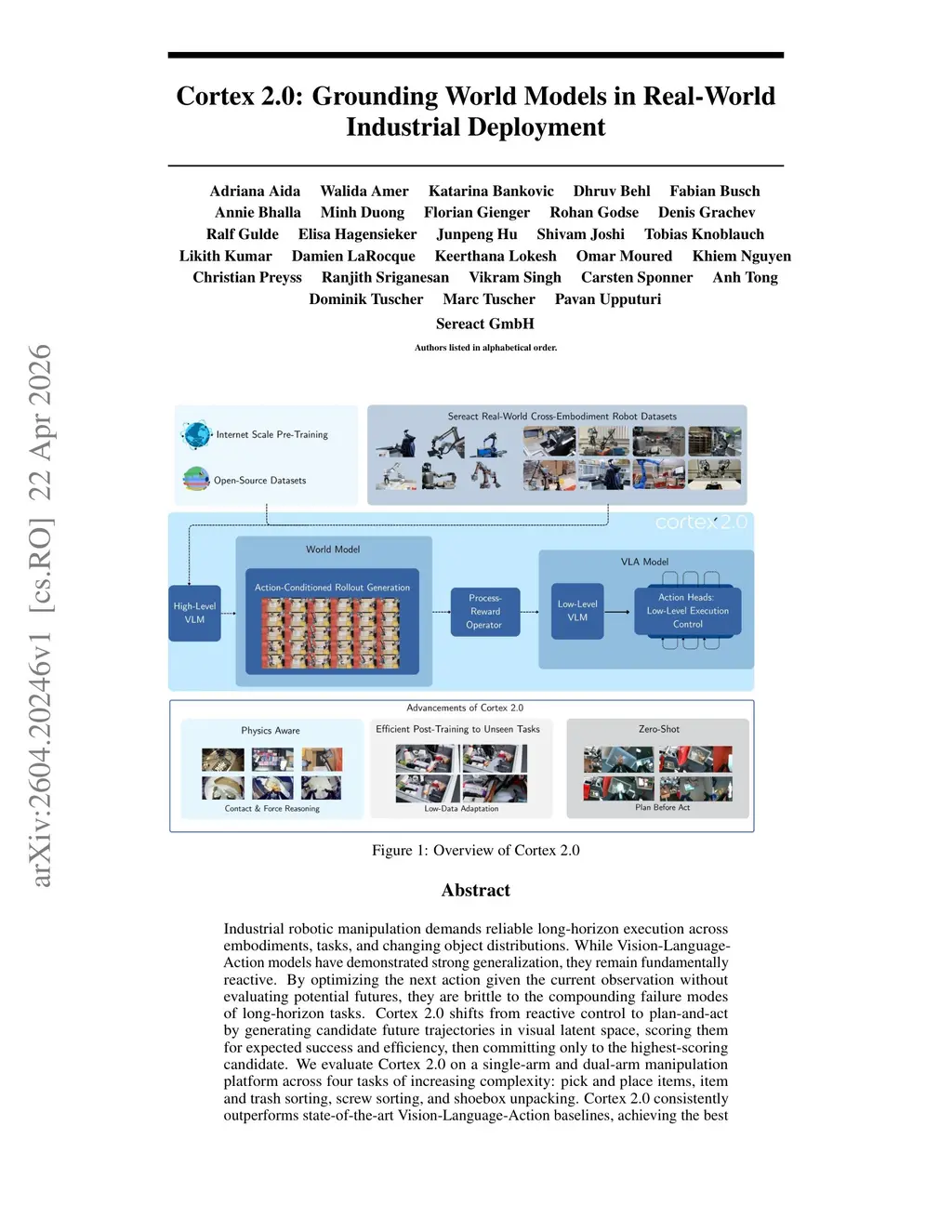
Industrial robotic manipulation demands reliable long-horizon execution across embodiments, tasks, and changing object distributions. While Vision-Language-Action models have demonstrated strong generalization, they remain fundamentally reactive. By optimizing the next action given the current observation without evaluating potential futures, they are brittle to the compounding failure modes of long-horizon tasks. Cortex 2.0 shifts from reactive control to plan-and-act by generating candidate future trajectories in visual latent space, scoring them for expected success and efficiency, then committing only to the highest-scoring candidate. We evaluate Cortex 2.0 on a single-arm and dual-arm manipulation platform across four tasks of increasing complexity: pick and place, item and trash sorting, screw sorting, and shoebox unpacking. Cortex 2.0 consistently outperforms state-of-the-art Vision-Language-Action baselines, achieving the best results across all tasks. The system remains reliable in unstructured environments characterized by heavy clutter, frequent occlusions, and contact-rich manipulation, where reactive policies fail. These results demonstrate that world-model-based planning can operate reliably in complex industrial environments.
View on arXiv