
MagicAgent: Towards Generalized Agent Planning
- LLMAGLM&Ro
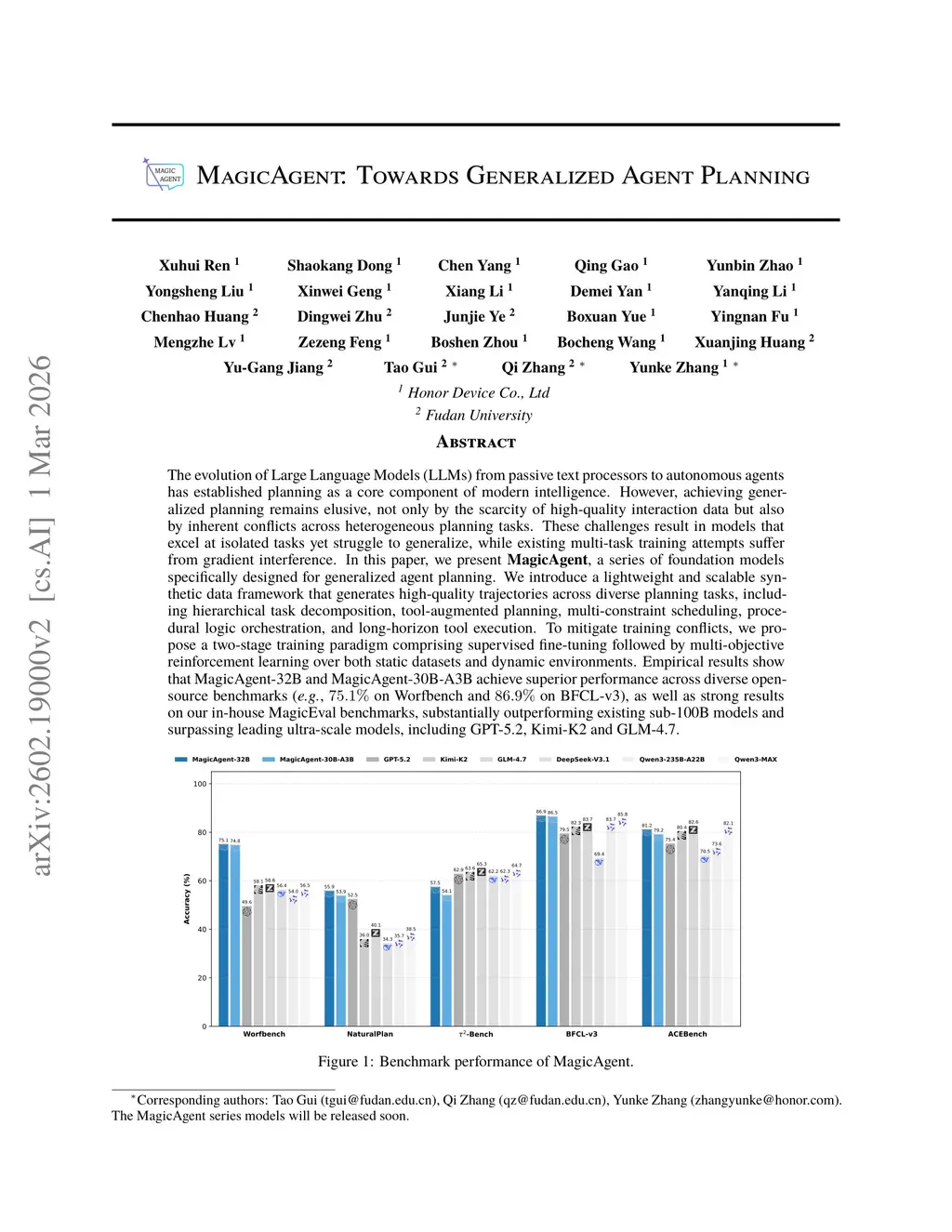
The evolution of Large Language Models (LLMs) from passive text processors to autonomous agents has established planning as a core component of modern intelligence. However, achieving generalized planning remains elusive, not only by the scarcity of high-quality interaction data but also by inherent conflicts across heterogeneous planning tasks. These challenges result in models that excel at isolated tasks yet struggle to generalize, while existing multi-task training attempts suffer from gradient interference. In this paper, we present \textbf{MagicAgent}, a series of foundation models specifically designed for generalized agent planning. We introduce a lightweight and scalable synthetic data framework that generates high-quality trajectories across diverse planning tasks, including hierarchical task decomposition, tool-augmented planning, multi-constraint scheduling, procedural logic orchestration, and long-horizon tool execution. To mitigate training conflicts, we propose a two-stage training paradigm comprising supervised fine-tuning followed by multi-objective reinforcement learning over both static datasets and dynamic environments. Empirical results show that MagicAgent-32B and MagicAgent-30B-A3B achieve superior performance across diverse open-source benchmarks (\emph{e.g.}, on Worfbench and on BFCL-v3), as well as strong results on our in-house MagicEval benchmarks, substantially outperforming existing sub-100B models and surpassing leading ultra-scale models, including GPT-5.2, Kimi-K2 and GLM-4.7.
View on arXiv