
LaST: Latent Spatio-Temporal Chain-of-Thought for Robotic Vision-Language-Action Model
- LM&RoLRM
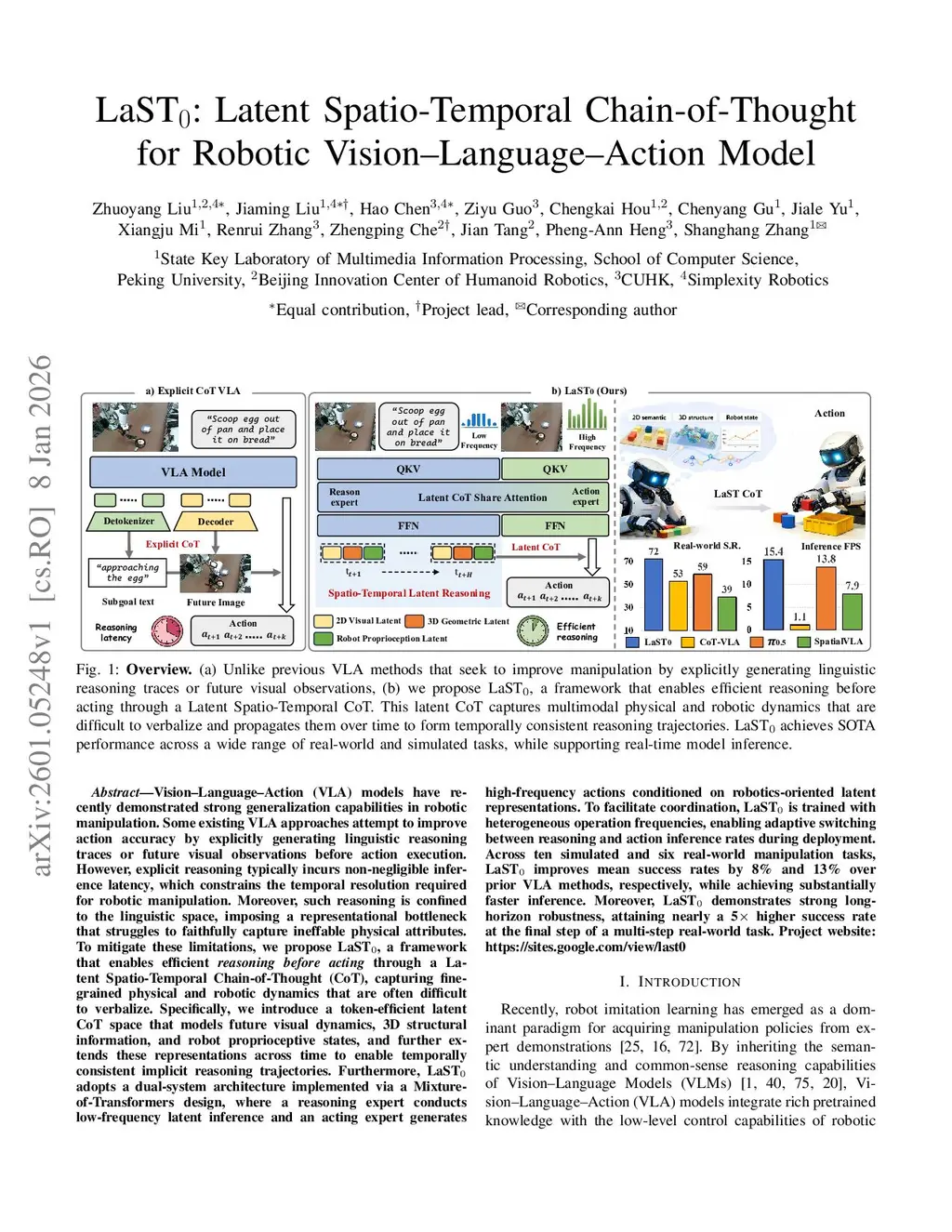
Vision-Language-Action (VLA) models have recently shown strong generalization, with some approaches seeking to explicitly generate linguistic reasoning traces or predict future observations prior to execution. However, explicit reasoning typically incurs non-negligible inference latency, which constrains the temporal resolution required for robotic manipulation. Moreover, such reasoning is confined to the linguistic space, imposing a representational bottleneck that struggles to faithfully capture ineffable physical attributes. To mitigate these limitations, we propose LaST, a framework that enables efficient reasoning before acting through a Latent Spatio-Temporal Chain-of-Thought (CoT), capturing fine-grained physical and robotic dynamics that are often difficult to verbalize. Specifically, we introduce a token-efficient latent CoT space that models future visual dynamics, 3D structural information, and robot proprioceptive states, and further extends these representations across time to enable temporally consistent implicit reasoning trajectories. Furthermore, LaST adopts a dual-system architecture implemented via a Mixture-of-Transformers design, where a reasoning expert conducts low-frequency latent inference and an acting expert generates high-frequency actions conditioned on robotics-oriented latent representations. To facilitate coordination, LaST is trained with heterogeneous operation frequencies, enabling adaptive switching during deployment. Across 10 real-world tasks spanning tabletop, mobile, and dexterous hand manipulation, LaST improves mean success rates by 13%, 14% and 14% over prior SOTA VLA methods, respectively.
View on arXiv