
Learning from Sparse Demonstrations
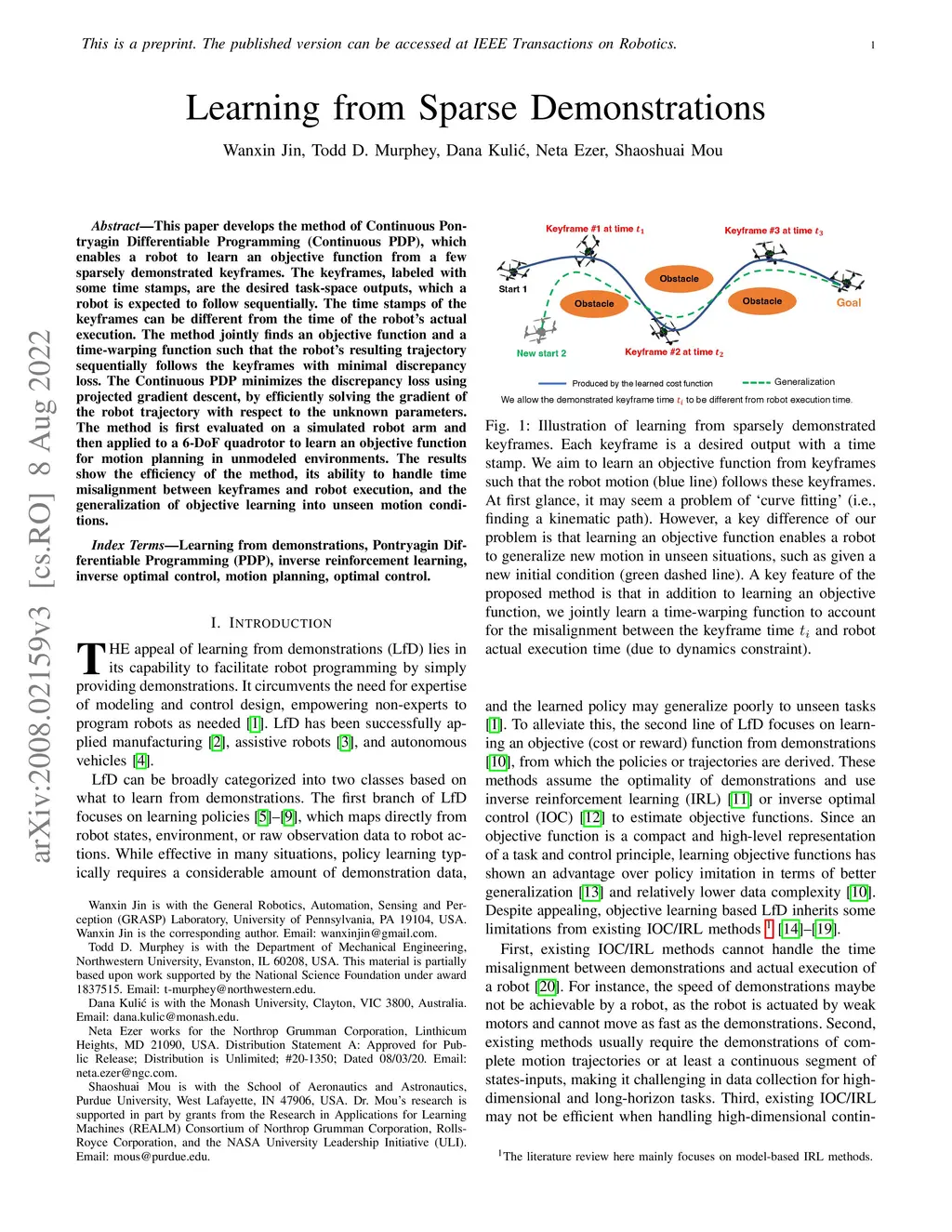
This paper develops the Continuous Pontryagin Differentiable Programming (Continuous PDP) method that enables a robot to learn a control utility function from a few number of sparsely demonstrated keyframes. The keyframes are few desired sequential outputs that a robot is wanted to follow at certain time instances. The duration of the keyframes may be different from that of the robot actual execution. The method jointly searches for a robot control utility function and a time-warping function such that the robot motion sequentially follows the given keyframes with minimal discrepancy loss. Continuous PDP minimizes the discrepancy loss using projected gradient descent, by efficiently solving the gradient of robot motion with respect to the unknown parameters. The method is first evaluated on a simulated two-link robot arm, and then applied to a 6-DoF maneuvering quadrotor to learn a utility function from keyframes for its motion planning in un-modeled environments with obstacles. The results show the efficiency of the method, its ability to handle time misalignment between keyframes and robot execution, and the generalization of the learned utility function into unseen motion conditions.
View on arXiv