
Parkinson's Disease Recognition Using SPECT Image and Interpretable-AI:
A Tutorial
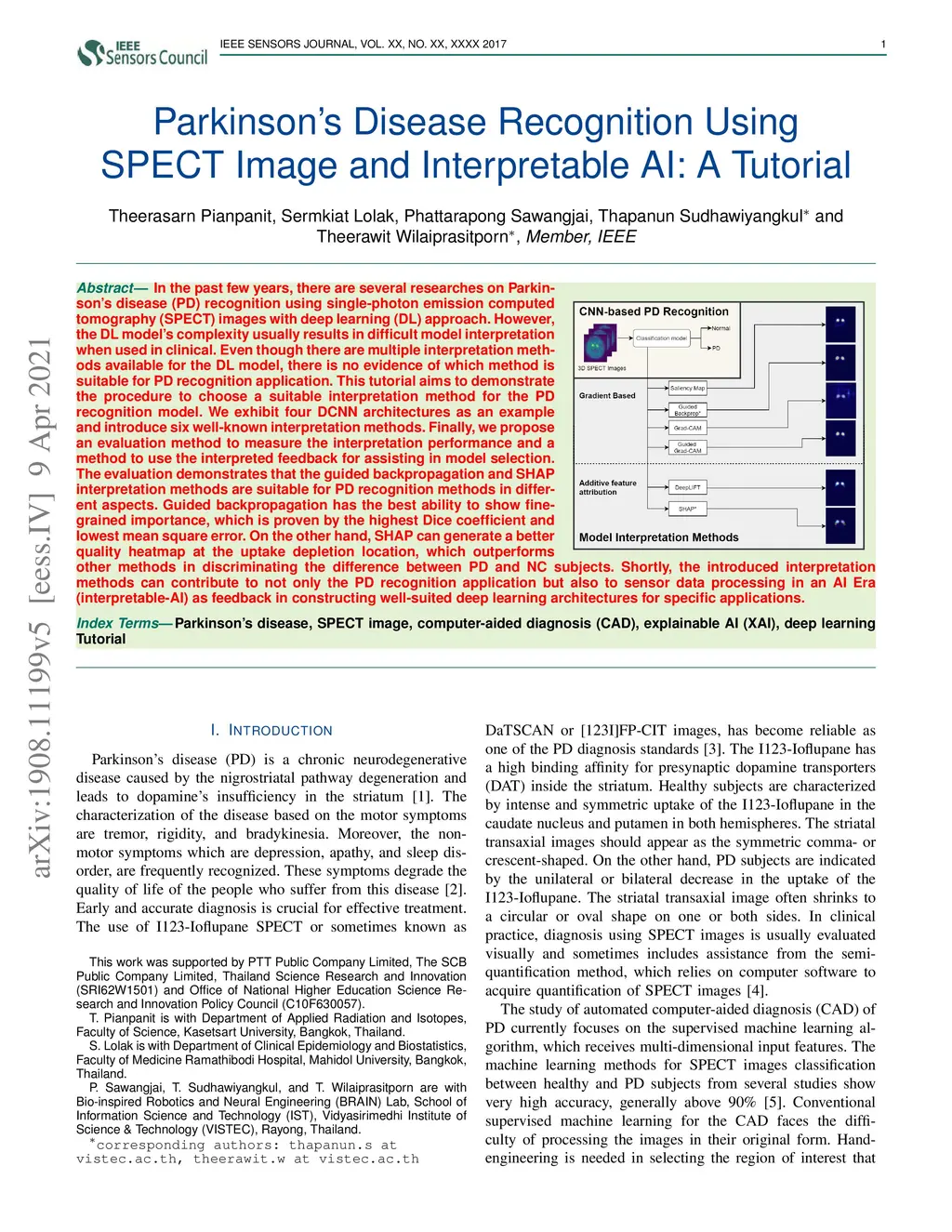
Parkinson's disease (PD) diagnosis mainly relies on the visual and semi-quantitative medical imaging analysis using single-photon emission computed tomography (SPECT). The deep learning approach benefits other machine learning methods because it does not rely on feature engineering. However, the deep learning model's complexity usually results in difficult model interpretation when used in clinical. The model interpretability depends on the interpretation method to reveal each pixel's contribution in the input image from an attention map. This tutorial aims to demonstrate the procedure to choose a suitable interpretation method for the PD recognition model. We exhibit four DCNN architectures as an example and introduce six well-known interpretation methods. We categorized the introduced methods into two significant groups. The first one is the gradient-based method, which focuses on using backpropagation to calculate the gradient that implies the input score of the target class's input features. The other group is the additive attribution methods, which alternatively construct a simpler model to explain the predictive model. Finally, we propose an evaluation method to measure the interpretation performance and a method to use the interpreted feedback for assisting in model selection. Shortly, the introduced interpretation methods can contribute to sensor data processing in an AI Era (interpretable-AI) as feedback in constructing well-suited deep learning architectures for specific applications.
View on arXiv