
Neural network interpretation of the Parkinson's disease diagnosis from
SPECT imaging
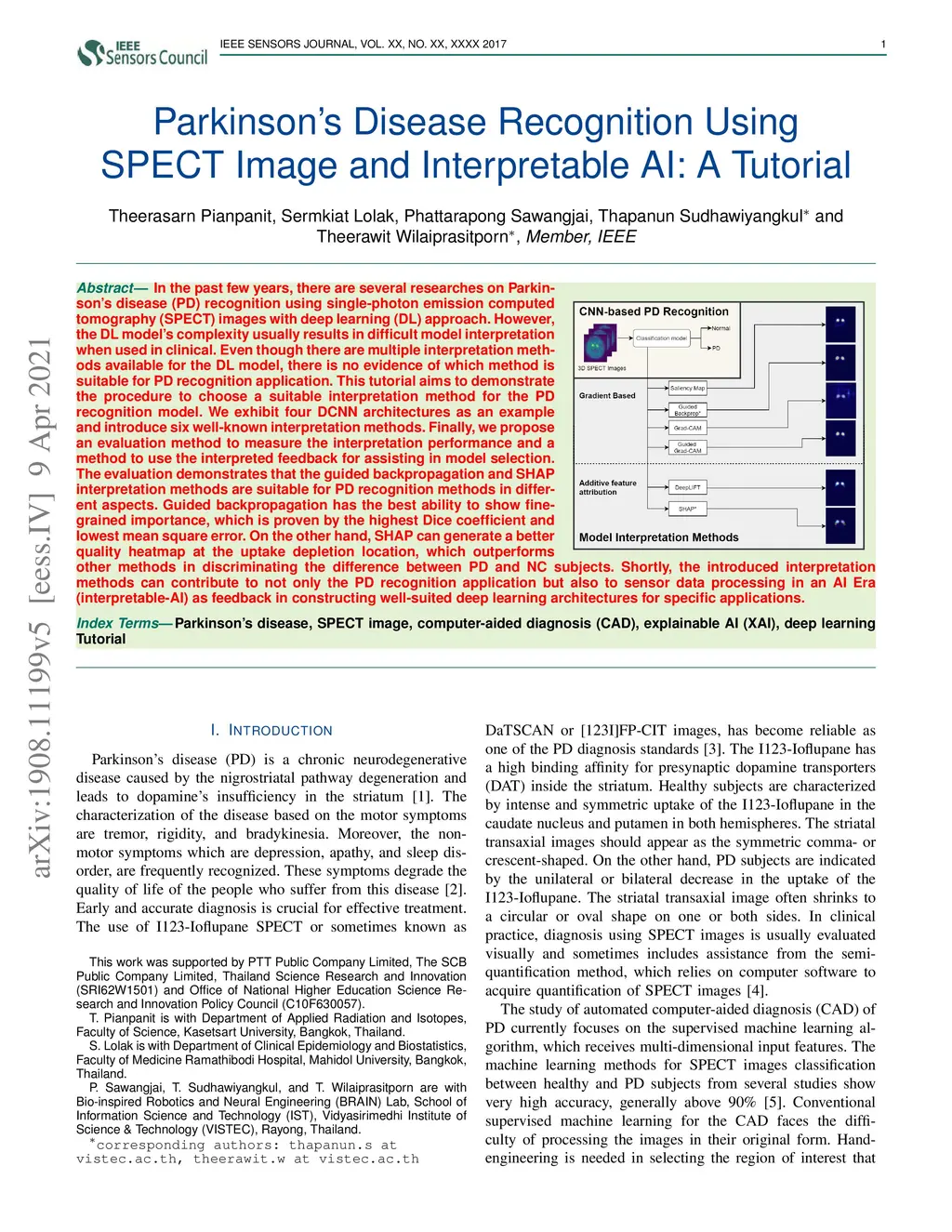
Parkinson's disease (PD) diagnosis mainly relies on the visual and semi-quantitative analysis of medical imaging using single-photon emission computed tomography (SPECT) with 123I-Ioflupane (DaTSCAN). The deep learning approach has benefits over other machine learning methods as the model does not rely on feature extraction. However, the complexity of the deep learning model usually results in the difficulty of model interpretation when used in the clinical settings. The model interpretability depends on the interpretation method to reveal the contribution of each pixel in the input image from an attention map. In this paper, we modify the architecture of six well-known interpretation methods to be applicable for 3-dimensional convolutional neural network (3D-CNN) and propose an evaluation method using the Dice coefficient to measure the interpretation performance. The four deep learning models based on the 3D-CNN with high accuracy were applied with our evaluation method. Guided backpropagation, which is one of the interpretation methods, showed the best interpretation performance when applied to the 3D-CNN model. Guided backpropagation generates the attention map that focuses on the location of striatal nuclei. By using the result from guided backpropagation, 3D-CNN architecture that displayed the highest classification and interpretation performance could be chosen for PD diagnosis.
View on arXiv