
A Mathematical Theory of Co-Design
- AI4CE
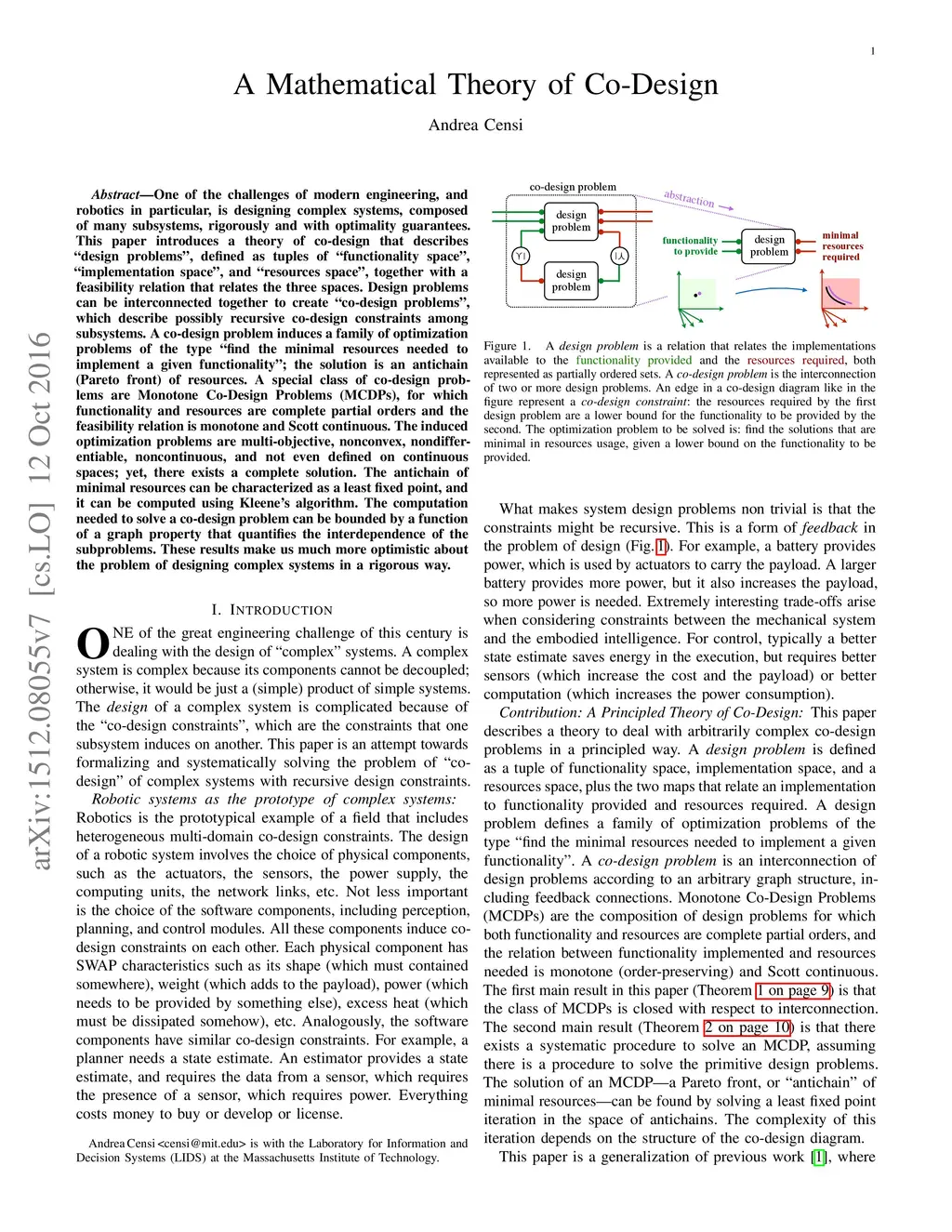
This paper describes a theory of "co-design", in which the objects of investigation are "design problems", defined as tuples of "functionality space", "implementation space", and "resources space", together with a feasibility relation that relates the three spaces. Design problems can be interconnected using composition operators equivalent to series, parallel, and feedback. A design problem induces a set of optimization problems of the type "find the minimal resources needed to implement a given functionality". The solution is an antichain (Pareto front) of resources. A special class of co-design problems are Monotone Co-Design Problems (MCDPs), for which functionality and resources are complete partial orders and the feasibility relation is monotone and Scott continuous. The induced optimization problems are multi-objective, nonconvex, nondifferentiable, noncontinuous, and not even defined on continuous spaces. Yet there exists a complete solution. The antichain of minimal resources can be characterized as the least fixed point of a certain map, and it can be computed using Kleene's algorithm. The computation needed to solve a co-design problem can be bounded as a function of a graph property (the "thickness" of a minimal feedback arc set) that quantifies the interdependence of the subproblems. These results make us much more optimistic about the problem of designing complex systems in a rigorous way.
View on arXiv