
A Mathematical Theory of Co-Design
- AI4CE
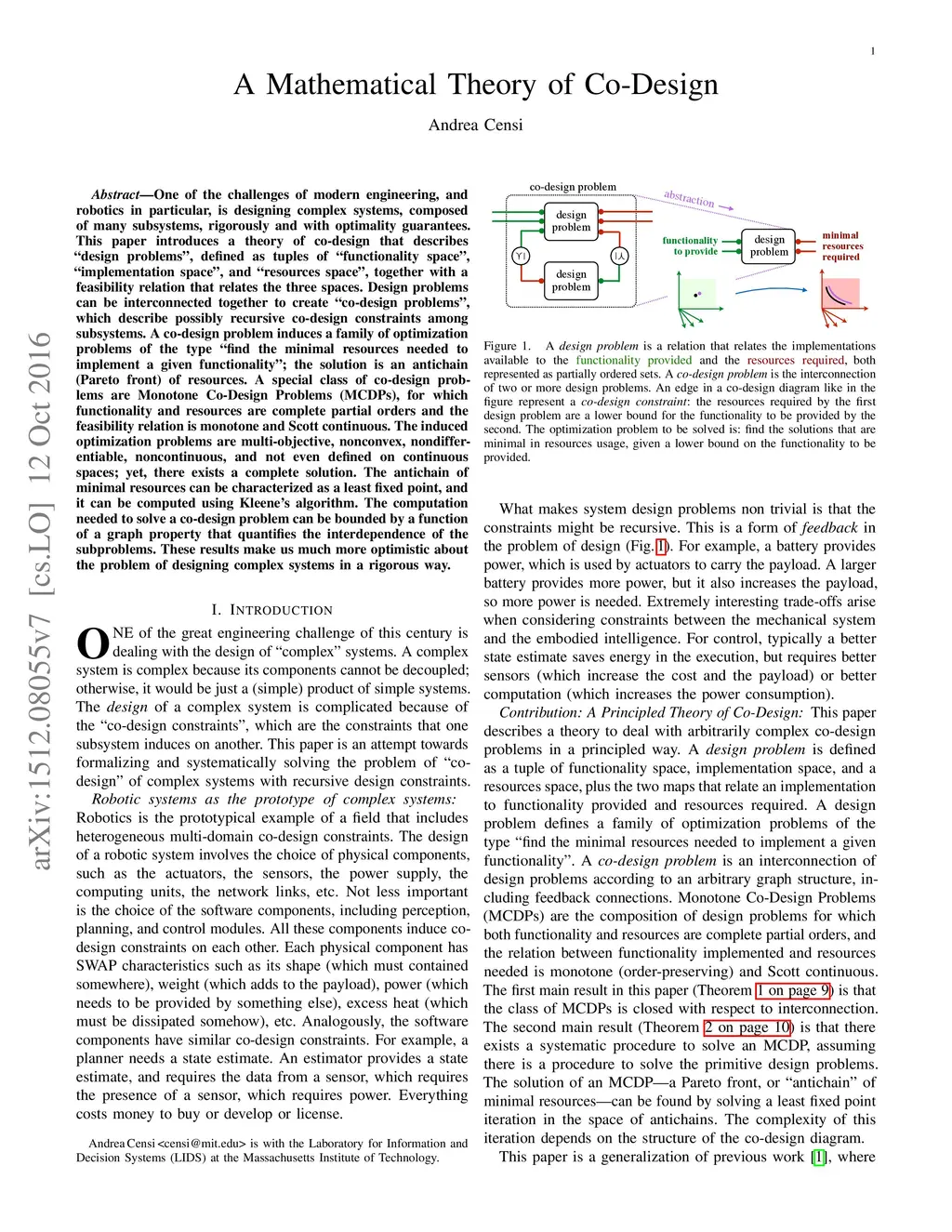
This paper describes a mathematical theory of "co-design", in which the objects of investigation are "design problems", defined as tuples of "functionality space", "implementation space", and "resources space", together with a feasibility relation. "Monotone" design problems are those for which functionality and resources are partially ordered and related by an order-preserving map. This condition is essentially the core of engineering: increasing the functionality does not decrease the resources needed. Specific examples are given for the domain of Robotics. Everything generalizes to everything else in engineering. Monotone Co-Design Problems (MCDPs) are defined as the composition of monotone design problems by three operations, equivalent to the concepts of series, parallel, and feedback. Monotonicity is preserved by these operations. Furthermore, the invariance group for these properties are all order isomorphisms, thus this is a completely intrinsic theory. As a class of optimization problems, MCDPs are multi-objective, nonconvex, nondifferentiable, noncontinuous, and not even defined on continuous spaces. Yet there exists a complete solution: if there exists a procedure to solve the primitive design problems, then there exists a systematic procedure to solve the larger MCDP. The solution of an MCDP can be cast as the problem of finding the least fixed point of a certain map on the set of resources antichains, a concept similar to Pareto fronts. The solution can be obtained by the iterative application of a map. In particular, no differential operators are needed. The iteration always converges: if it converges to finite values, that is guaranteed to be the set of minimal resources. If it converges to infinity (in a sense to be specified), then the sequence is a certificate of infeasibility.
View on arXiv