
Optimally Bridging Semantics and Data: Generative Semantic Communication via Schrödinger Bridge
- OT
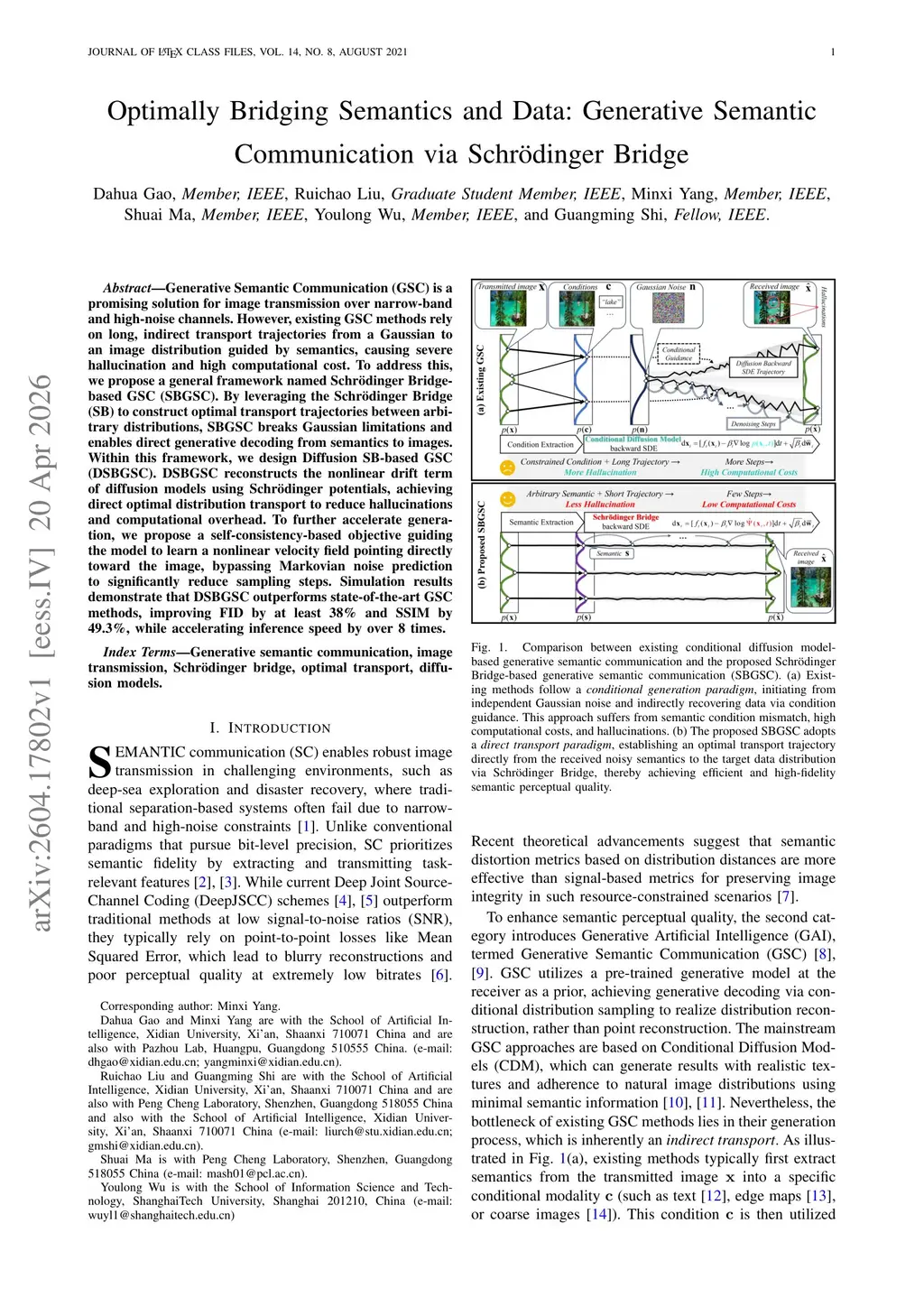
Generative Semantic Communication (GSC) is a promising solution for image transmission over narrow-band and high-noise channels. However, existing GSC methods rely on long, indirect transport trajectories from a Gaussian to an image distribution guided by semantics, causing severe hallucination and high computational cost. To address this, we propose a general framework named Schrödinger Bridge-based GSC (SBGSC). By leveraging the Schrödinger Bridge (SB) to construct optimal transport trajectories between arbitrary distributions, SBGSC breaks Gaussian limitations and enables direct generative decoding from semantics to images. Within this framework, we design Diffusion SB-based GSC (DSBGSC). DSBGSC reconstructs the nonlinear drift term of diffusion models using Schrödinger potentials, achieving direct optimal distribution transport to reduce hallucinations and computational overhead. To further accelerate generation, we propose a self-consistency-based objective guiding the model to learn a nonlinear velocity field pointing directly toward the image, bypassing Markovian noise prediction to significantly reduce sampling steps. Simulation results demonstrate that DSBGSC outperforms state-of-the-art GSC methods, improving FID by at least 38% and SSIM by 49.3%, while accelerating inference speed by over 8 times.
View on arXiv