
Understanding and Enforcing Weight Disentanglement in Task Arithmetic
- OODMoMeCoGe
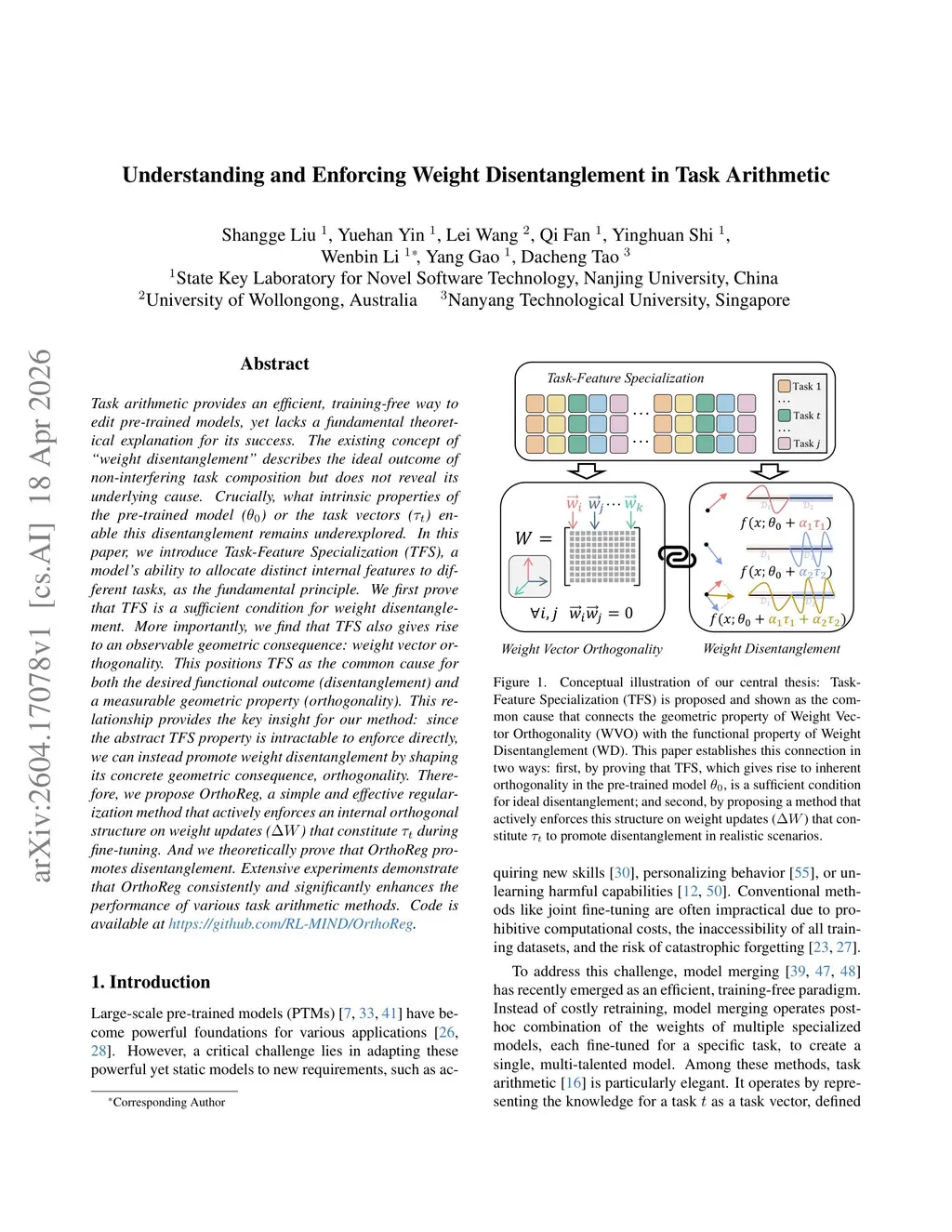
Task arithmetic provides an efficient, training-free way to edit pre-trained models, yet lacks a fundamental theoretical explanation for its success. The existing concept of ``weight disentanglement" describes the ideal outcome of non-interfering task composition but does not reveal its underlying cause. Crucially, what intrinsic properties of the pre-trained model () or the task vectors () enable this disentanglement remains underexplored. In this paper, we introduce Task-Feature Specialization (TFS), a model's ability to allocate distinct internal features to different tasks, as the fundamental principle. We first prove that TFS is a sufficient condition for weight disentanglement. More importantly, we find that TFS also gives rise to an observable geometric consequence: weight vector orthogonality. This positions TFS as the common cause for both the desired functional outcome (disentanglement) and a measurable geometric property (orthogonality). This relationship provides the key insight for our method: since the abstract TFS property is intractable to enforce directly, we can instead promote weight disentanglement by shaping its concrete geometric consequence, orthogonality. Therefore, we propose OrthoReg, a simple and effective regularization method that actively enforces an internal orthogonal structure on weight updates () that constitute during fine-tuning. And we theoretically prove that OrthoReg promotes disentanglement. Extensive experiments demonstrate that OrthoReg consistently and significantly enhances the performance of various task arithmetic methods. Code is available at \href{this https URL}{this https URL}.
View on arXiv