
Neural Gabor Splatting: Enhanced Gaussian Splatting with Neural Gabor for High-frequency Surface Reconstruction
- 3DGS
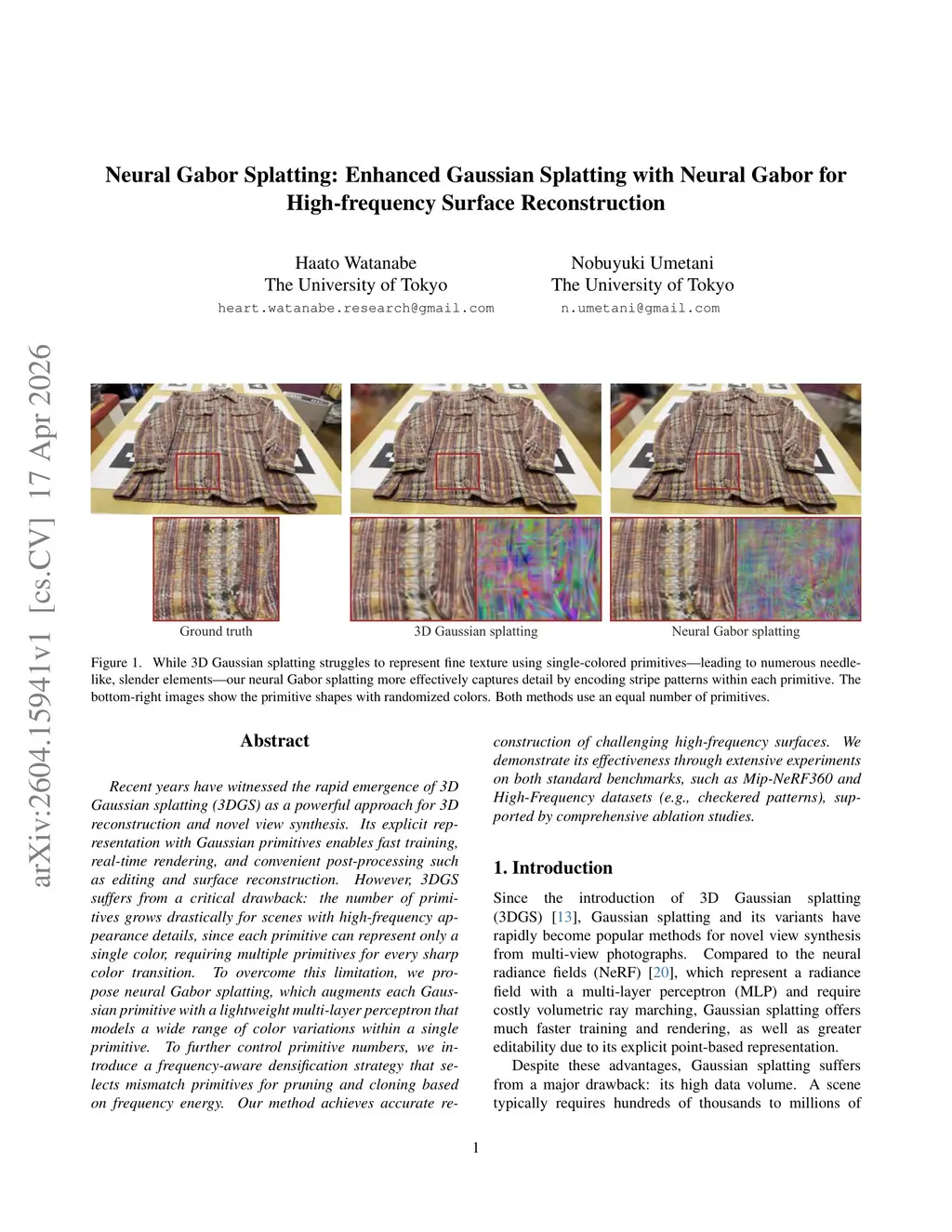
Recent years have witnessed the rapid emergence of 3D Gaussian splatting (3DGS) as a powerful approach for 3D reconstruction and novel view synthesis. Its explicit representation with Gaussian primitives enables fast training, real-time rendering, and convenient post-processing such as editing and surface reconstruction. However, 3DGS suffers from a critical drawback: the number of primitives grows drastically for scenes with high-frequency appearance details, since each primitive can represent only a single color, requiring multiple primitives for every sharp color transition. To overcome this limitation, we propose neural Gabor splatting, which augments each Gaussian primitive with a lightweight multi-layer perceptron that models a wide range of color variations within a single primitive. To further control primitive numbers, we introduce a frequency-aware densification strategy that selects mismatch primitives for pruning and cloning based on frequency energy. Our method achieves accurate reconstruction of challenging high-frequency surfaces. We demonstrate its effectiveness through extensive experiments on both standard benchmarks, such as Mip-NeRF360 and High-Frequency datasets (e.g., checkered patterns), supported by comprehensive ablation studies.
View on arXiv