
OmniGCD: Abstracting Generalized Category Discovery for Modality Agnosticism
- ObjDVLM
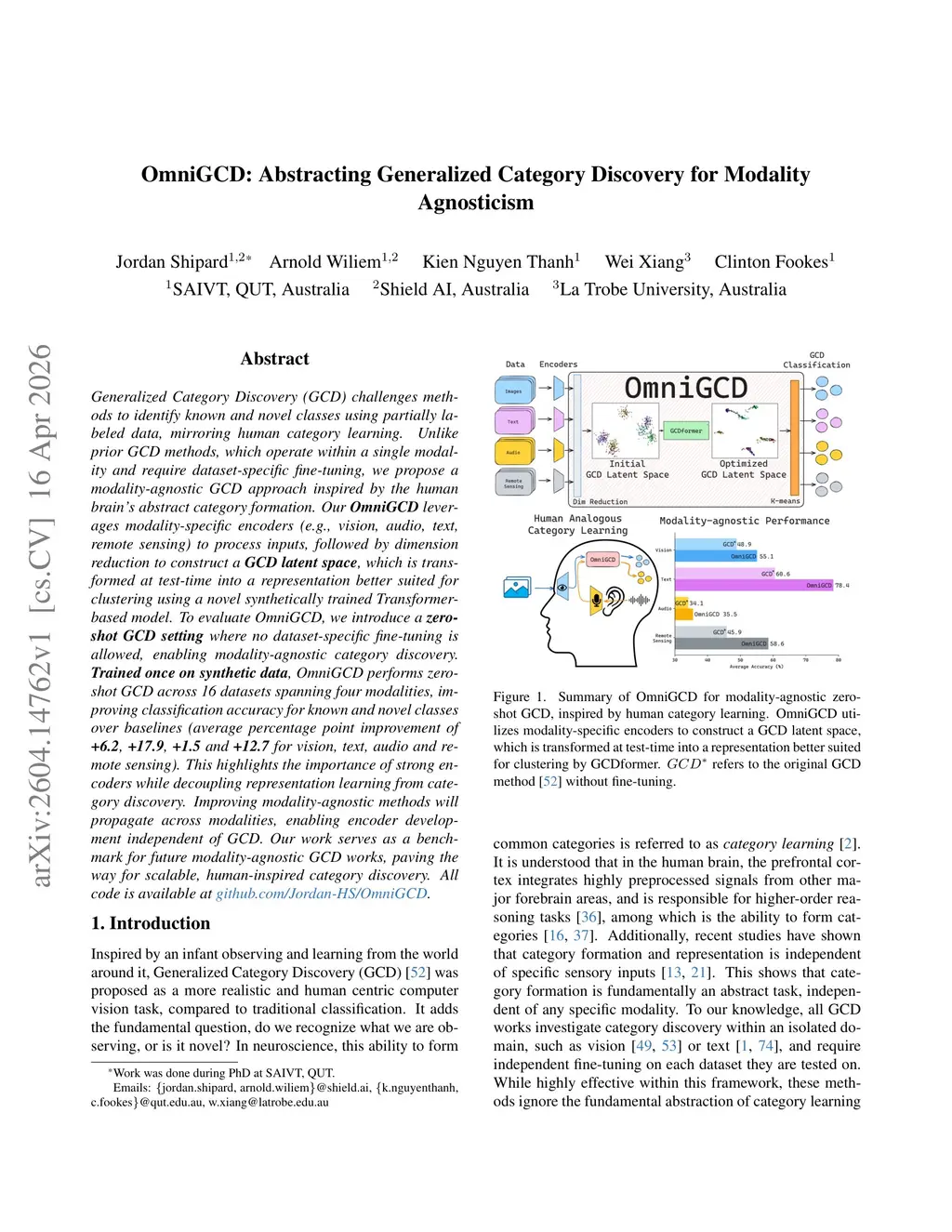
Generalized Category Discovery (GCD) challenges methods to identify known and novel classes using partially labeled data, mirroring human category learning. Unlike prior GCD methods, which operate within a single modality and require dataset-specific fine-tuning, we propose a modality-agnostic GCD approach inspired by the human brain's abstract category formation. Our leverages modality-specific encoders (e.g., vision, audio, text, remote sensing) to process inputs, followed by dimension reduction to construct a , which is transformed at test-time into a representation better suited for clustering using a novel synthetically trained Transformer-based model. To evaluate OmniGCD, we introduce a where no dataset-specific fine-tuning is allowed, enabling modality-agnostic category discovery. , OmniGCD performs zero-shot GCD across 16 datasets spanning four modalities, improving classification accuracy for known and novel classes over baselines (average percentage point improvement of , , and for vision, text, audio and remote sensing). This highlights the importance of strong encoders while decoupling representation learning from category discovery. Improving modality-agnostic methods will propagate across modalities, enabling encoder development independent of GCD. Our work serves as a benchmark for future modality-agnostic GCD works, paving the way for scalable, human-inspired category discovery. All code is available
View on arXiv