
CSRA: Controlled Spectral Residual Augmentation for Robust Sepsis Prediction
- OOD
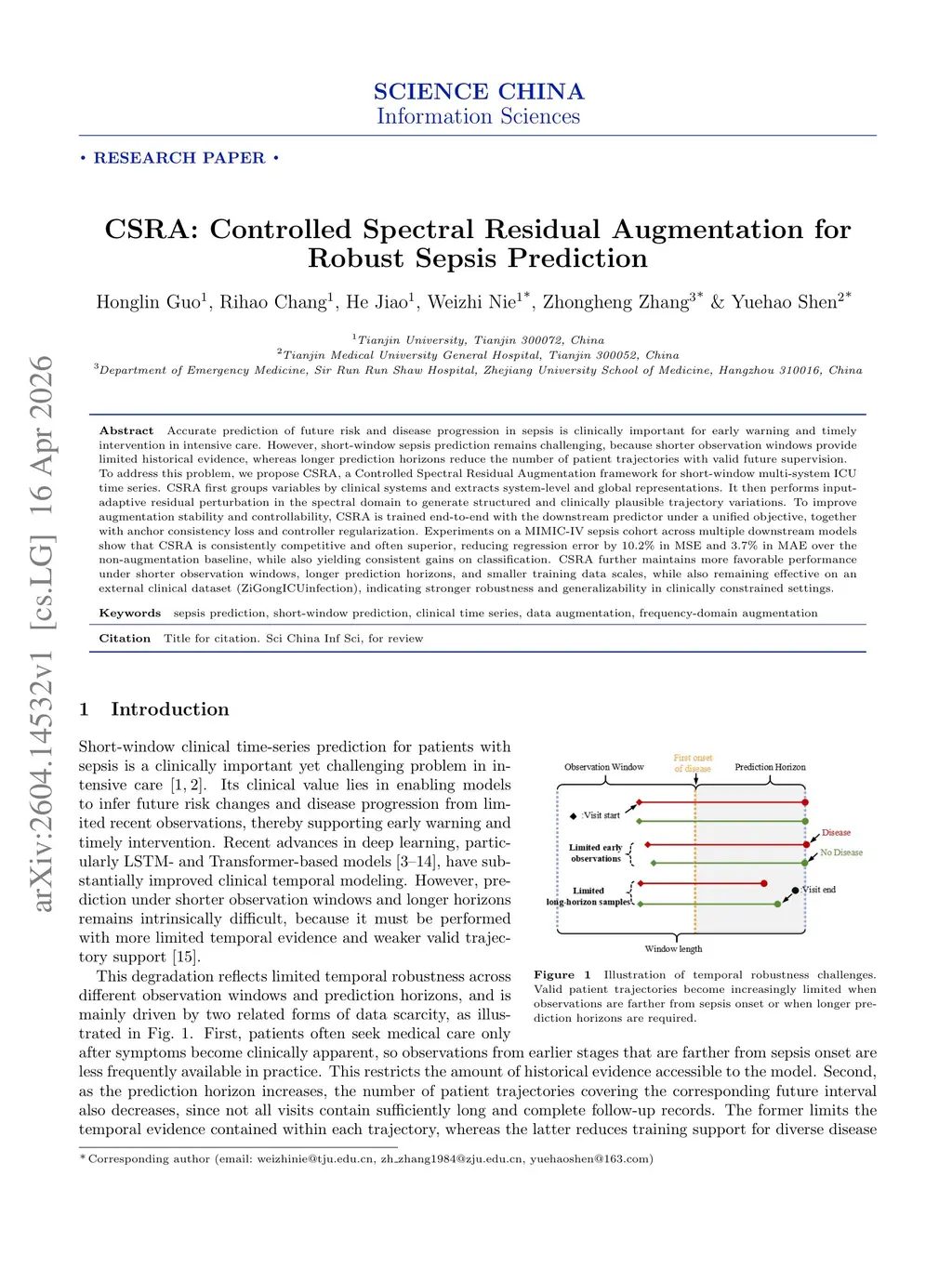
Accurate prediction of future risk and disease progression in sepsis is clinically important for early warning and timely intervention in intensive care. However, short-window sepsis prediction remains challenging, because shorter observation windows provide limited historical evidence, whereas longer prediction horizons reduce the number of patient trajectories with valid future supervision. To address this problem, we propose CSRA, a Controlled Spectral Residual Augmentation framework for short-window multi-system ICU time series. CSRA first groups variables by clinical systems and extracts system-level and global representations. It then performs input-adaptive residual perturbation in the spectral domain to generate structured and clinically plausible trajectory variations. To improve augmentation stability and controllability, CSRA is trained end-to-end with the downstream predictor under a unified objective, together with anchor consistency loss and controller regularization. Experiments on a MIMIC-IV sepsis cohort across multiple downstream models show that CSRA is consistently competitive and often superior, reducing regression error by 10.2\% in MSE and 3.7\% in MAE over the non-augmentation baseline, while also yielding consistent gains on classification. CSRA further maintains more favorable performance under shorter observation windows, longer prediction horizons, and smaller training data scales, while also remaining effective on an external clinical dataset~(ZiGongICUinfection), indicating stronger robustness and generalizability in clinically constrained settings.
View on arXiv