
Investigating Performance and Practices with Univariate Distribution Charts
- CML
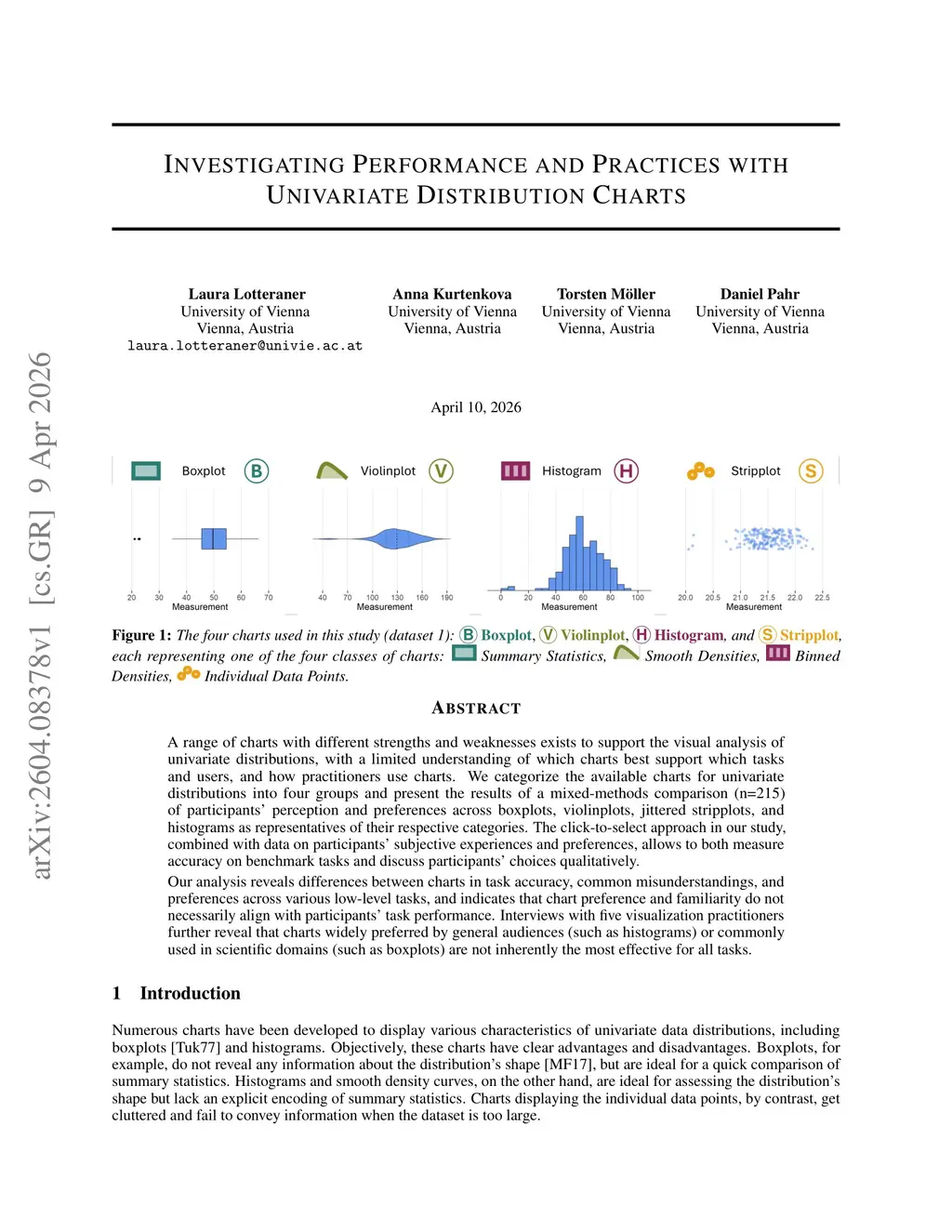
A range of charts with different strengths and weaknesses exists to support the visual analysis of univariate distributions, with a limited understanding of which charts best support which tasks and users, and how practitioners use charts. We categorize the available charts for univariate distributions into four groups and present the results of a mixed-methods comparison (n=215) of participants' perception and preferences across boxplots, violinplots, jittered stripplots, and histograms as representatives of their respective categories. The click-to-select approach in our study, combined with data on participants' subjective experiences and preferences, allows to both measure accuracy on benchmark tasks and discuss participants' choices qualitatively. Our analysis reveals differences between charts in task accuracy, common misunderstandings, and preferences across various low-level tasks, and indicates that chart preference and familiarity do not necessarily align with participants' task performance. Interviews with five visualization practitioners further reveal that charts widely preferred by general audiences (such as histograms) or commonly used in scientific domains (such as boxplots) are not inherently the most effective for all tasks.
View on arXiv