
Blending Human and LLM Expertise to Detect Hallucinations and Omissions in Mental Health Chatbot Responses
- AILawAI4MHELM
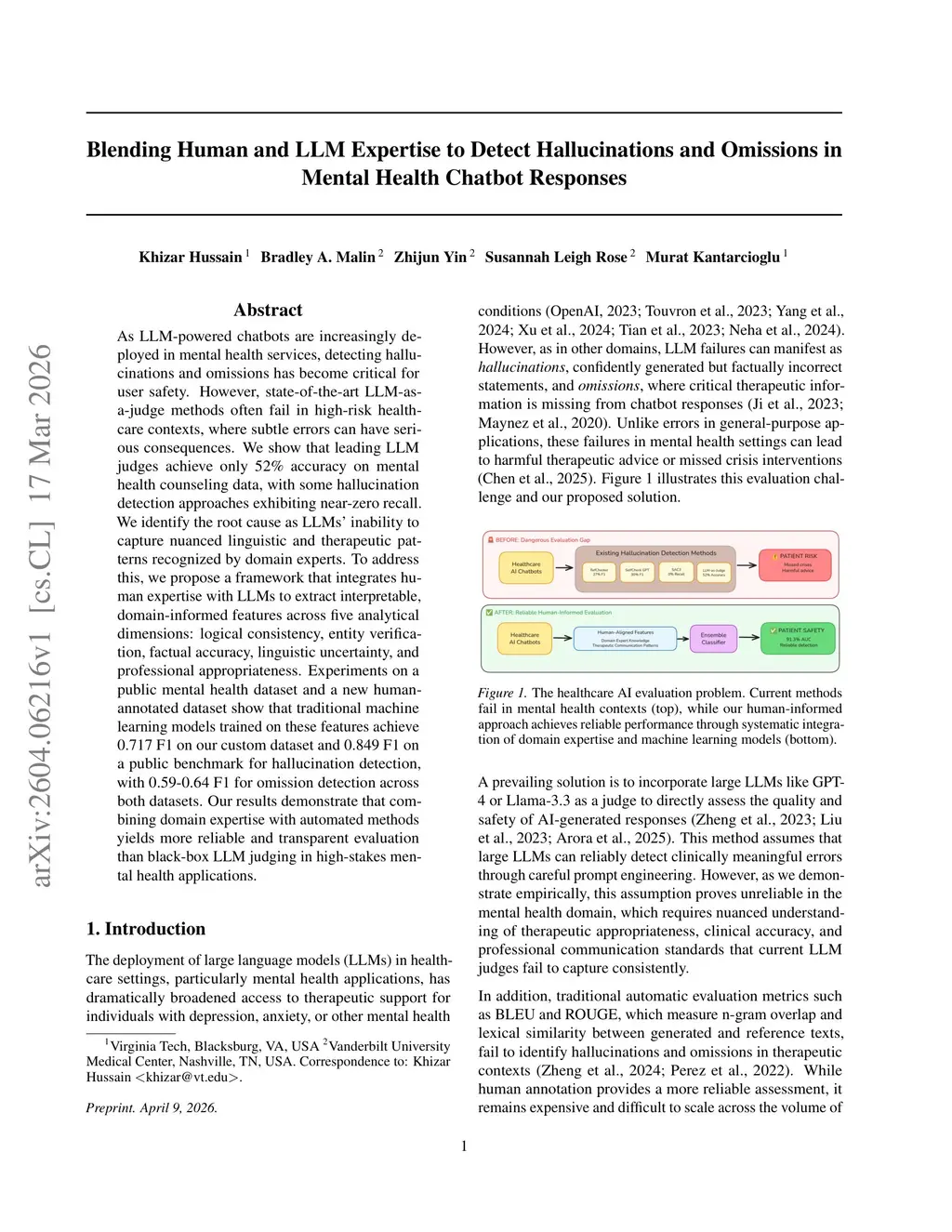
As LLM-powered chatbots are increasingly deployed in mental health services, detecting hallucinations and omissions has become critical for user safety. However, state-of-the-art LLM-as-a-judge methods often fail in high-risk healthcarecontexts, where subtle errors can have serious consequences. We show that leading LLM judges achieve only 52% accuracy on mental health counseling data, with some hallucination detection approaches exhibiting near-zero recall. We identify the root causeas LLMs' inability to capture nuanced linguistic and therapeutic patterns recognized by domain experts. To address this, we propose a framework that integrates human expertise with LLMs to extract interpretable, domain-informed features across fiveanalytical dimensions: logical consistency, entity verification, factual accuracy, linguistic uncertainty, and professional appropriateness. Experiments on a public mental health dataset and a new human-annotated dataset show that traditional machinelearning models trained on these features achieve 0.717 F1 on our custom dataset and 0.849 F1 on a public benchmark for hallucination detection, with 0.59-0.64 F1 for omission detection across both datasets. Our results demonstrate that combining domainexpertise with automated methods yields more reliable and transparent evaluation than black-box LLM judging in high-stakes mental health applications.
View on arXiv