
Understanding User Privacy Perceptions of GenAI Smartphones
- PILM
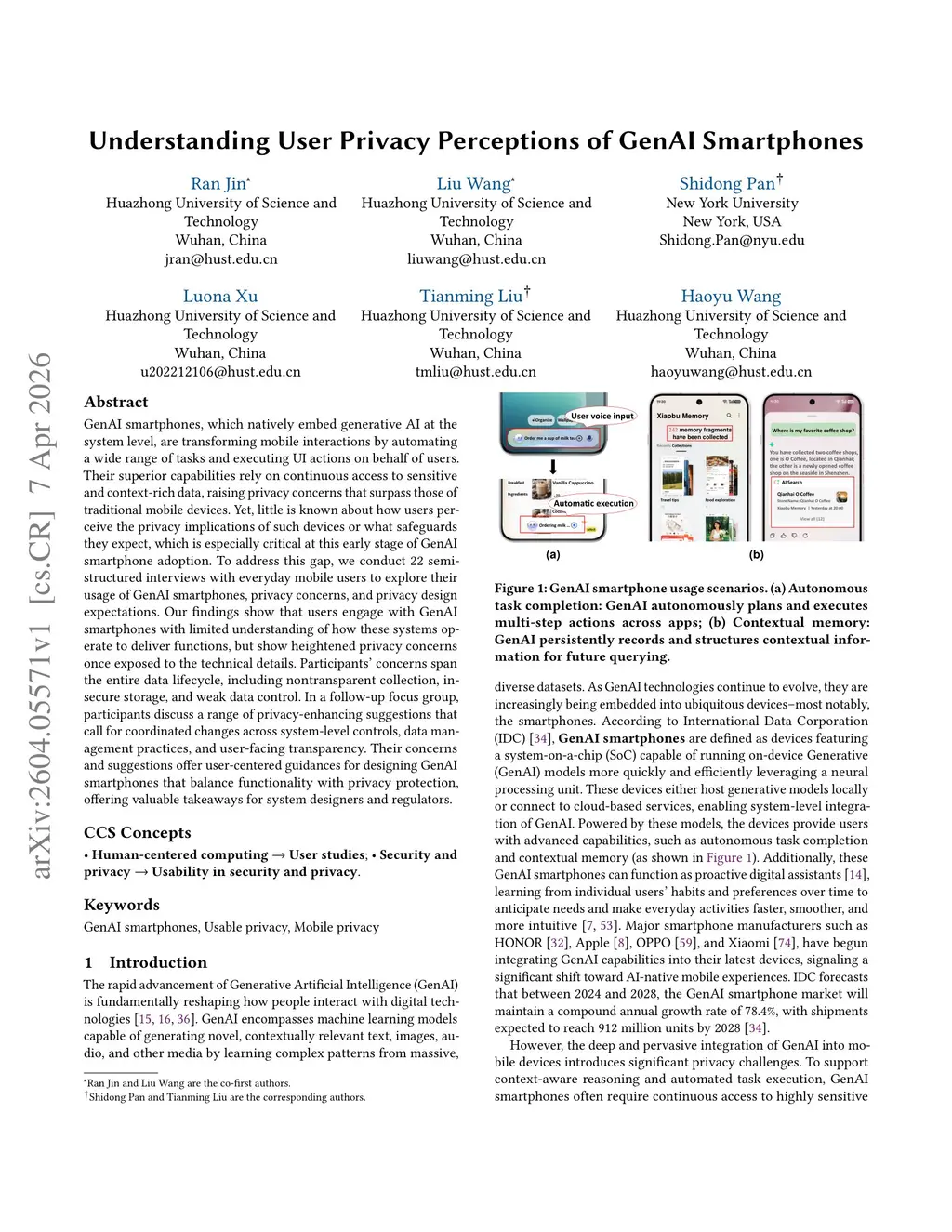
GenAI smartphones, which natively embed generative AI at the system level, are transforming mobile interactions by automating a wide range of tasks and executing UI actions on behalf of users. Their superior capabilities rely on continuous access to sensitive and context-rich data, raising privacy concerns that surpass those of traditional mobile devices. Yet, little is known about how users perceive the privacy implications of such devices or what safeguards they expect, which is especially critical at this early stage of GenAI smartphone adoption. To address this gap, we conduct 22 semi-structured interviews with everyday mobile users to explore their usage of GenAI smartphones, privacy concerns, and privacy design expectations. Our findings show that users engage with GenAI smartphones with limited understanding of how these systems operate to deliver functions, but show heightened privacy concerns once exposed to the technical details. Participants' concerns span the entire data lifecycle, including nontransparent collection, insecure storage, and weak data control. In a follow-up focus group, participants discuss a range of privacy-enhancing suggestions that call for coordinated changes across system-level controls, data management practices, and user-facing transparency. Their concerns and suggestions offer user-centered guidances for designing GenAI smartphones that balance functionality with privacy protection, offering valuable takeaways for system designers and regulators.
View on arXiv