
Learning Additively Compositional Latent Actions for Embodied AI
- PINNCLLCoGe
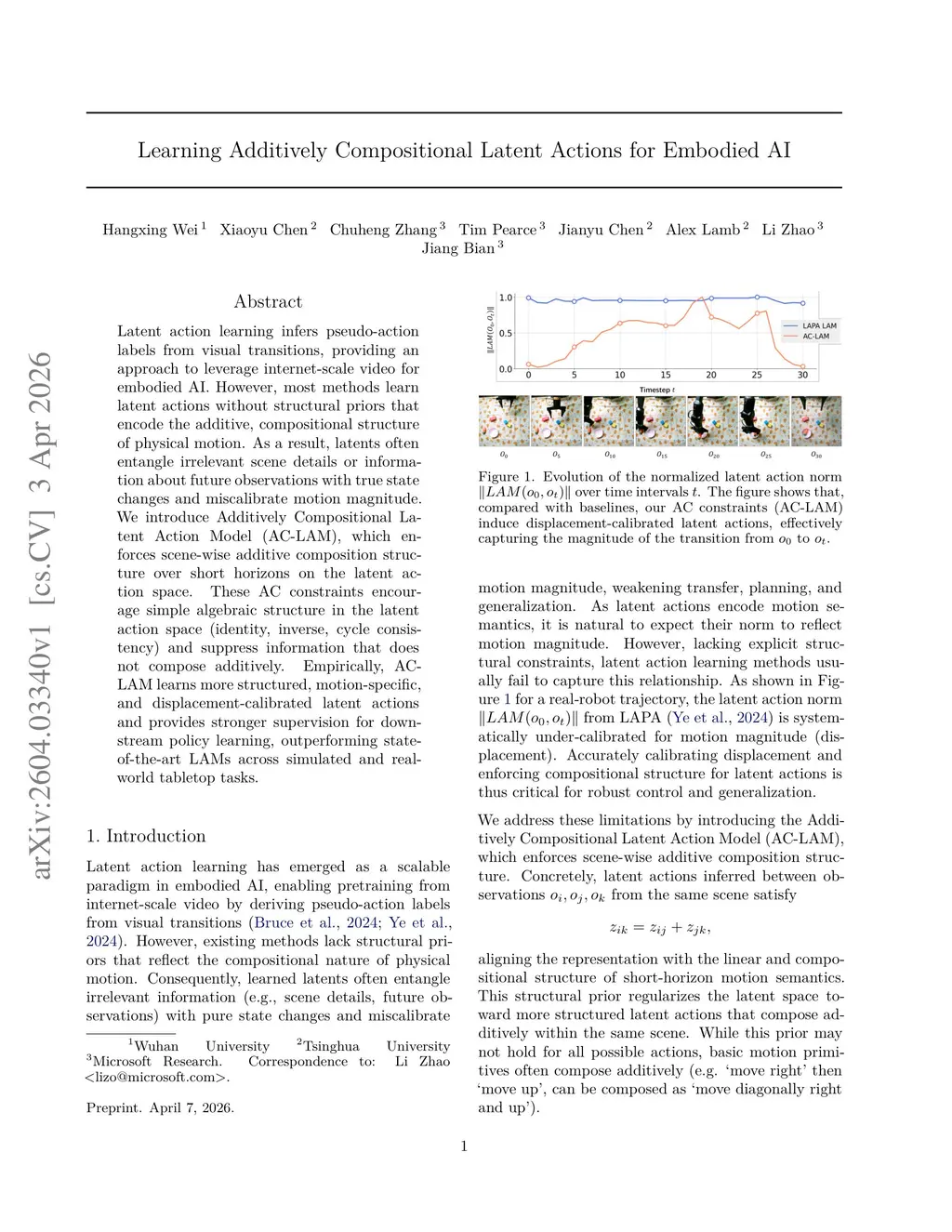
Latent action learning infers pseudo-action labels from visual transitions, providing an approach to leverage internet-scale video for embodied AI. However, most methods learn latent actions without structural priors that encode the additive, compositional structure of physical motion. As a result, latents often entangle irrelevant scene details or information about future observations with true state changes and miscalibrate motion magnitude. We introduce Additively Compositional Latent Action Model (AC-LAM), which enforces scene-wise additive composition structure over short horizons on the latent action space. These AC constraints encourage simple algebraic structure in the latent action space~(identity, inverse, cycle consistency) and suppress information that does not compose additively. Empirically, AC-LAM learns more structured, motion-specific, and displacement-calibrated latent actions and provides stronger supervision for downstream policy learning, outperforming state-of-the-art LAMs across simulated and real-world tabletop tasks.
View on arXiv