
InstructTable: Improving Table Structure Recognition Through Instructions
- LMTD
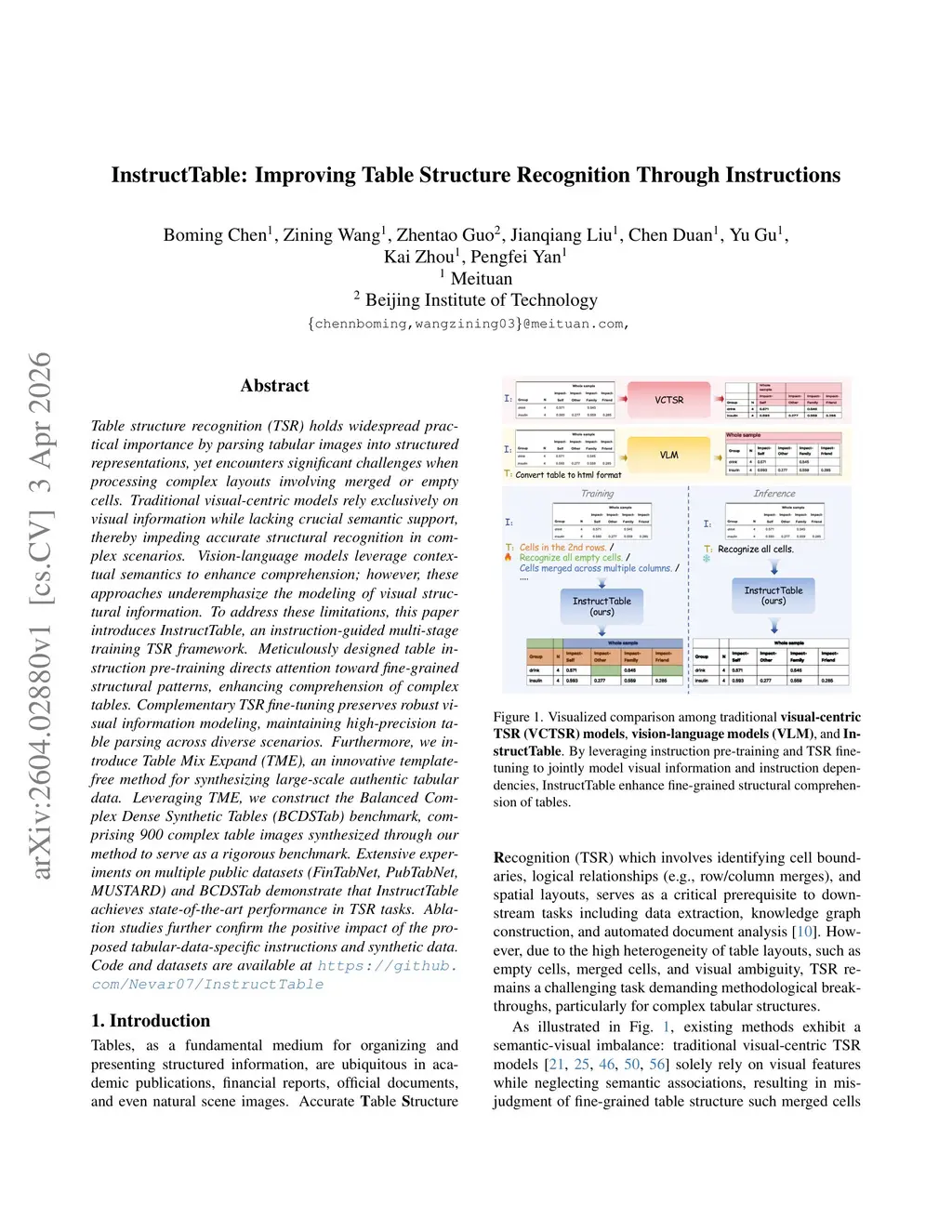
Table structure recognition (TSR) holds widespread practical importance by parsing tabular images into structured representations, yet encounters significant challenges when processing complex layouts involving merged or empty cells. Traditional visual-centric models rely exclusively on visual information while lacking crucial semantic support, thereby impeding accurate structural recognition in complex scenarios. Vision-language models leverage contextual semantics to enhance comprehension; however, these approaches underemphasize the modeling of visual structural information. To address these limitations, this paper introduces InstructTable, an instruction-guided multi-stage training TSR framework. Meticulously designed table instruction pre-training directs attention toward fine-grained structural patterns, enhancing comprehension of complex tables. Complementary TSR fine-tuning preserves robust visual information modeling, maintaining high-precision table parsing across diverse scenarios. Furthermore, we introduce Table Mix Expand (TME), an innovative template-free method for synthesizing large-scale authentic tabular data. Leveraging TME, we construct the Balanced Complex Dense Synthetic Tables (BCDSTab) benchmark, comprising 900 complex table images synthesized through our method to serve as a rigorous benchmark. Extensive experiments on multiple public datasets (FinTabNet, PubTabNet, MUSTARD) and BCDSTab demonstrate that InstructTable achieves state-of-the-art performance in TSR tasks. Ablation studies further confirm the positive impact of the proposed tabular-data-specific instructions and synthetic data.
View on arXiv