
FlashSign: Pose-Free Guidance for Efficient Sign Language Video Generation
- DiffMSLRVGen
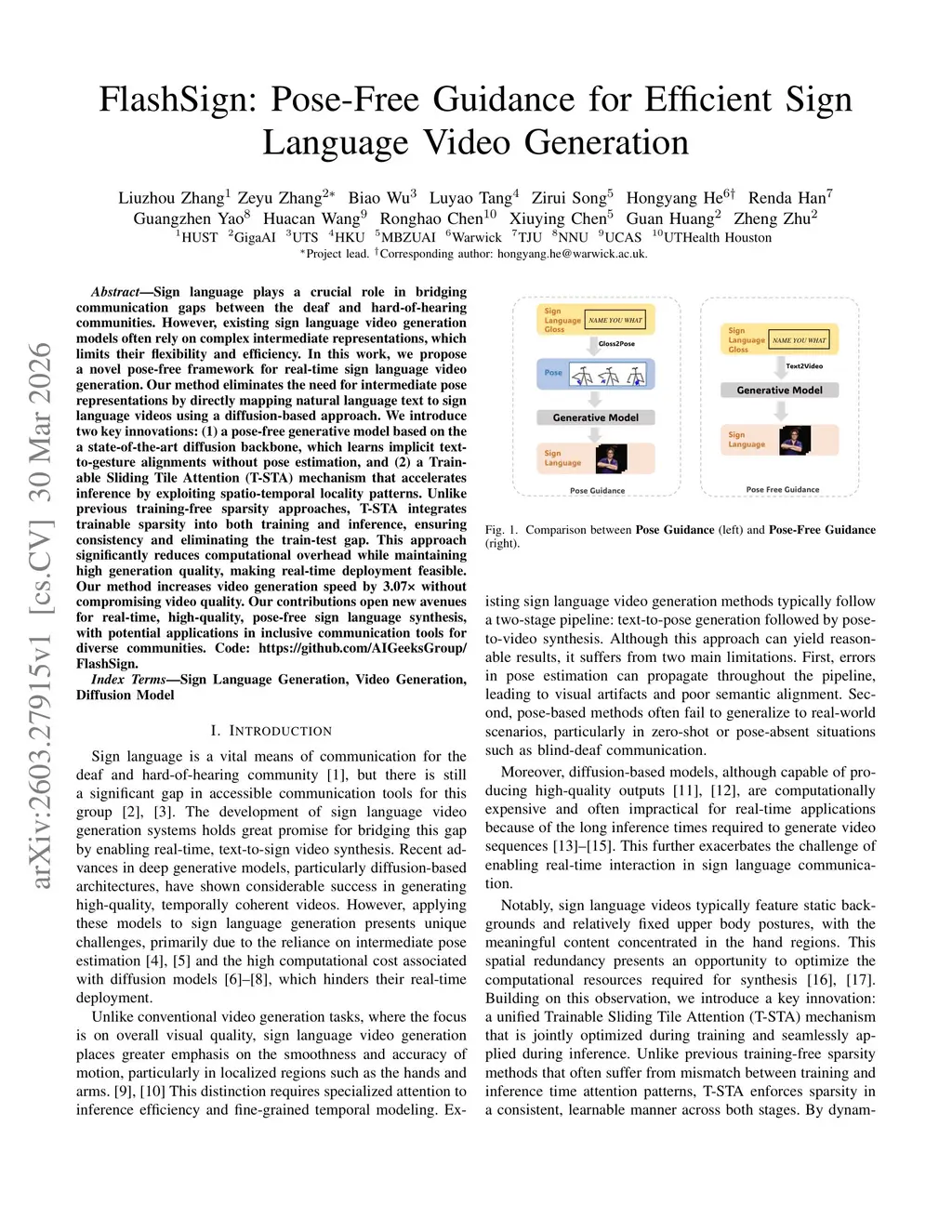
Sign language plays a crucial role in bridging communication gaps between the deaf and hard-of-hearing communities. However, existing sign language video generation models often rely on complex intermediate representations, which limits their flexibility and efficiency. In this work, we propose a novel pose-free framework for real-time sign language video generation. Our method eliminates the need for intermediate pose representations by directly mapping natural language text to sign language videos using a diffusion-based approach. We introduce two key innovations: (1) a pose-free generative model based on the a state-of-the-art diffusion backbone, which learns implicit text-to-gesture alignments without pose estimation, and (2) a Trainable Sliding Tile Attention (T-STA) mechanism that accelerates inference by exploiting spatio-temporal locality patterns. Unlike previous training-free sparsity approaches, T-STA integrates trainable sparsity into both training and inference, ensuring consistency and eliminating the train-test gap. This approach significantly reduces computational overhead while maintaining high generation quality, making real-time deployment feasible. Our method increases video generation speed by 3.07x without compromising video quality. Our contributions open new avenues for real-time, high-quality, pose-free sign language synthesis, with potential applications in inclusive communication tools for diverse communities. Code:this https URL.
View on arXiv