
Fast and Reliable Gradients for Deformables Across Frictional Contact Regimes
- AI4CE
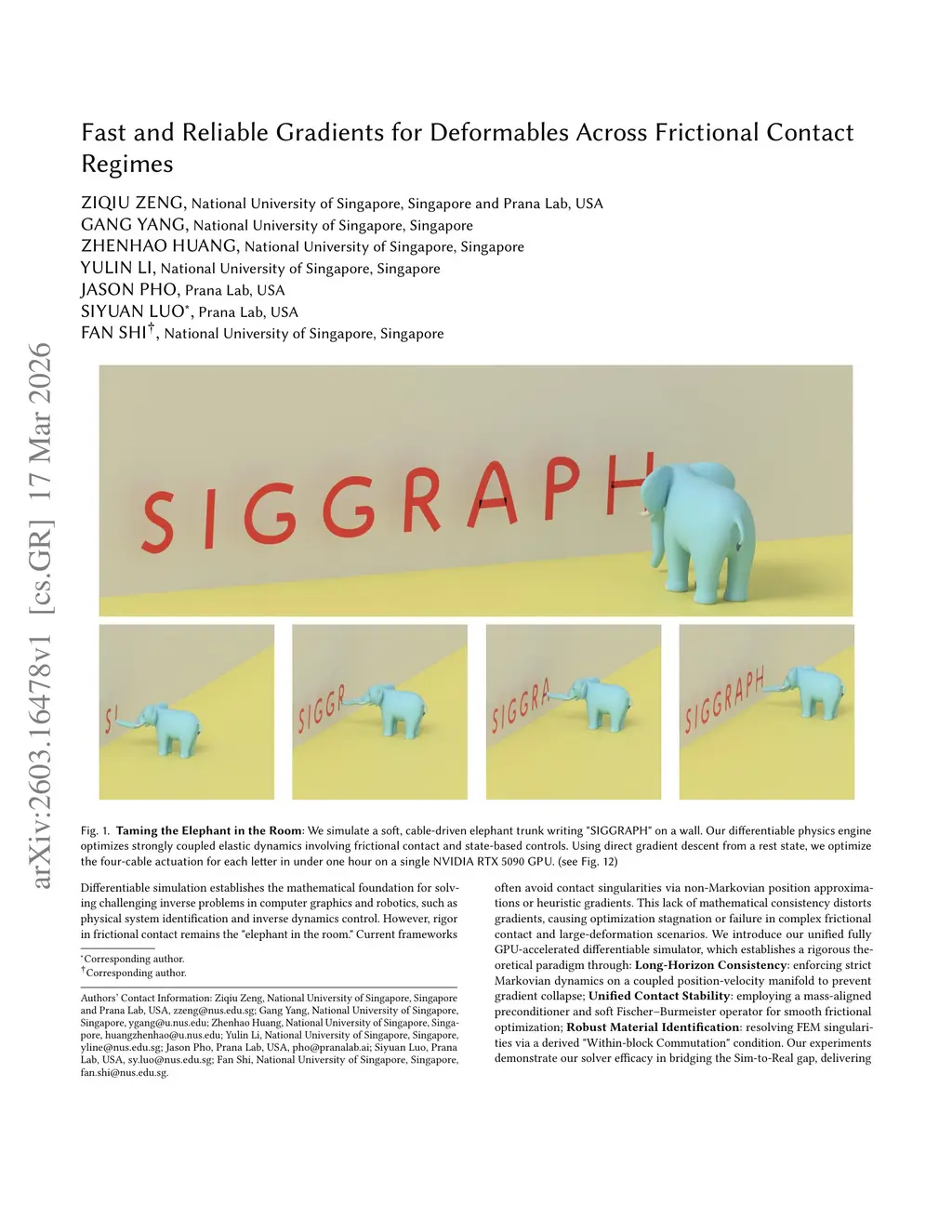
Differentiable simulation establishes the mathematical foundation for solving challenging inverse problems in computer graphics and robotics, such as physical system identification and inverse dynamics control. However, rigor in frictional contact remains the "elephant in the room." Current frameworks often avoid contact singularities via non-Markovian position approximations or heuristic gradients. This lack of mathematical consistency distorts gradients, causing optimization stagnation or failure in complex frictional contact and large-deformation scenarios. We introduce our unified fully GPU-accelerated differentiable simulator, which establishes a rigorous theoretical paradigm through: Long-Horizon Consistency: enforcing strict Markovian dynamics on a coupled position-velocity manifold to prevent gradient collapse; Unified Contact Stability: employing a mass-aligned preconditioner and soft Fischer--Burmeister operator for smooth frictional optimization; Robust Material Identification: resolving FEM singularities via a derived "Within-block Commutation" condition. Our experiments demonstrate our solver efficacy in bridging the Sim-to-Real gap, delivering precise, low-noise gradients in contact-rich tasks like dexterous manipulation and cloth folding. By mitigating the gradient instability issues common in conventional approaches, our framework significantly enhances the fidelity of physical system identification and control.
View on arXiv