
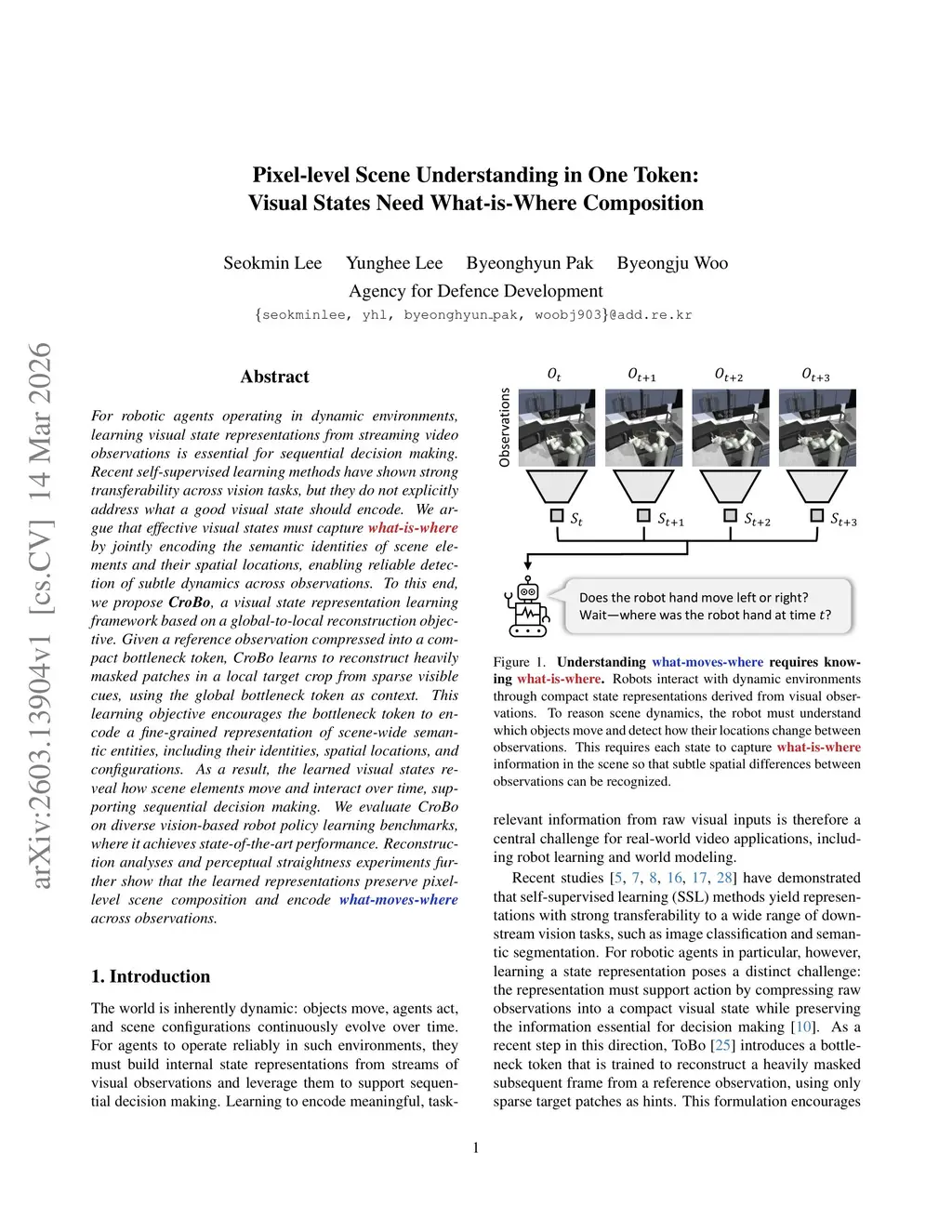
For robotic agents operating in dynamic environments, learning visual state representations from streaming video observations is essential for sequential decision making. Recent self-supervised learning methods have shown strong transferability across vision tasks, but they do not explicitly address what a good visual state should encode. We argue that effective visual states must capture what-is-where by jointly encoding the semantic identities of scene elements and their spatial locations, enabling reliable detection of subtle dynamics across observations. To this end, we propose CroBo, a visual state representation learning framework based on a global-to-local reconstruction objective. Given a reference observation compressed into a compact bottleneck token, CroBo learns to reconstruct heavily masked patches in a local target crop from sparse visible cues, using the global bottleneck token as context. This learning objective encourages the bottleneck token to encode a fine-grained representation of scene-wide semantic entities, including their identities, spatial locations, and configurations. As a result, the learned visual states reveal how scene elements move and interact over time, supporting sequential decision making. We evaluate CroBo on diverse vision-based robot policy learning benchmarks, where it achieves state-of-the-art performance. Reconstruction analyses and perceptual straightness experiments further show that the learned representations preserve pixel-level scene composition and encode what-moves-where across observations. Project page available at:this https URL.
View on arXiv