
Examining Reasoning LLMs-as-Judges in Non-Verifiable LLM Post-Training
- ELMLRM
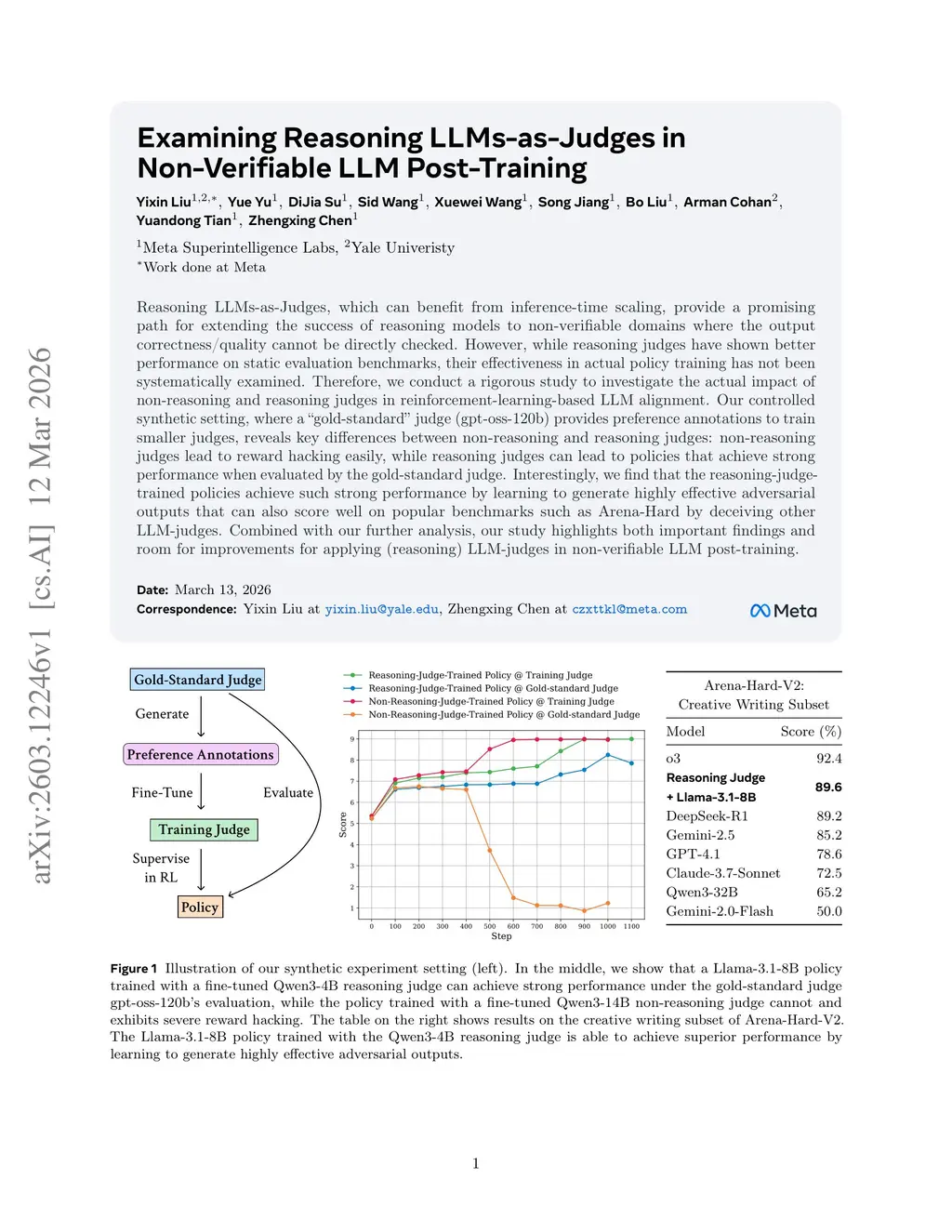
Reasoning LLMs-as-Judges, which can benefit from inference-time scaling, provide a promising path for extending the success of reasoning models to non-verifiable domains where the output correctness/quality cannot be directly checked. However, while reasoning judges have shown better performance on static evaluation benchmarks, their effectiveness in actual policy training has not been systematically examined. Therefore, we conduct a rigorous study to investigate the actual impact of non-reasoning and reasoning judges in reinforcement-learning-based LLM alignment. Our controlled synthetic setting, where a "gold-standard" judge (gpt-oss-120b) provides preference annotations to train smaller judges, reveals key differences between non-reasoning and reasoning judges: non-reasoning judges lead to reward hacking easily, while reasoning judges can lead to policies that achieve strong performance when evaluated by the gold-standard judge. Interestingly, we find that the reasoning-judge-trained policies achieve such strong performance by learning to generate highly effective adversarial outputs that can also score well on popular benchmarks such as Arena-Hard by deceiving other LLM-judges. Combined with our further analysis, our study highlights both important findings and room for improvements for applying (reasoning) LLM-judges in non-verifiable LLM post-training.
View on arXiv