
Measuring AI Agents' Progress on Multi-Step Cyber Attack Scenarios
- ELM
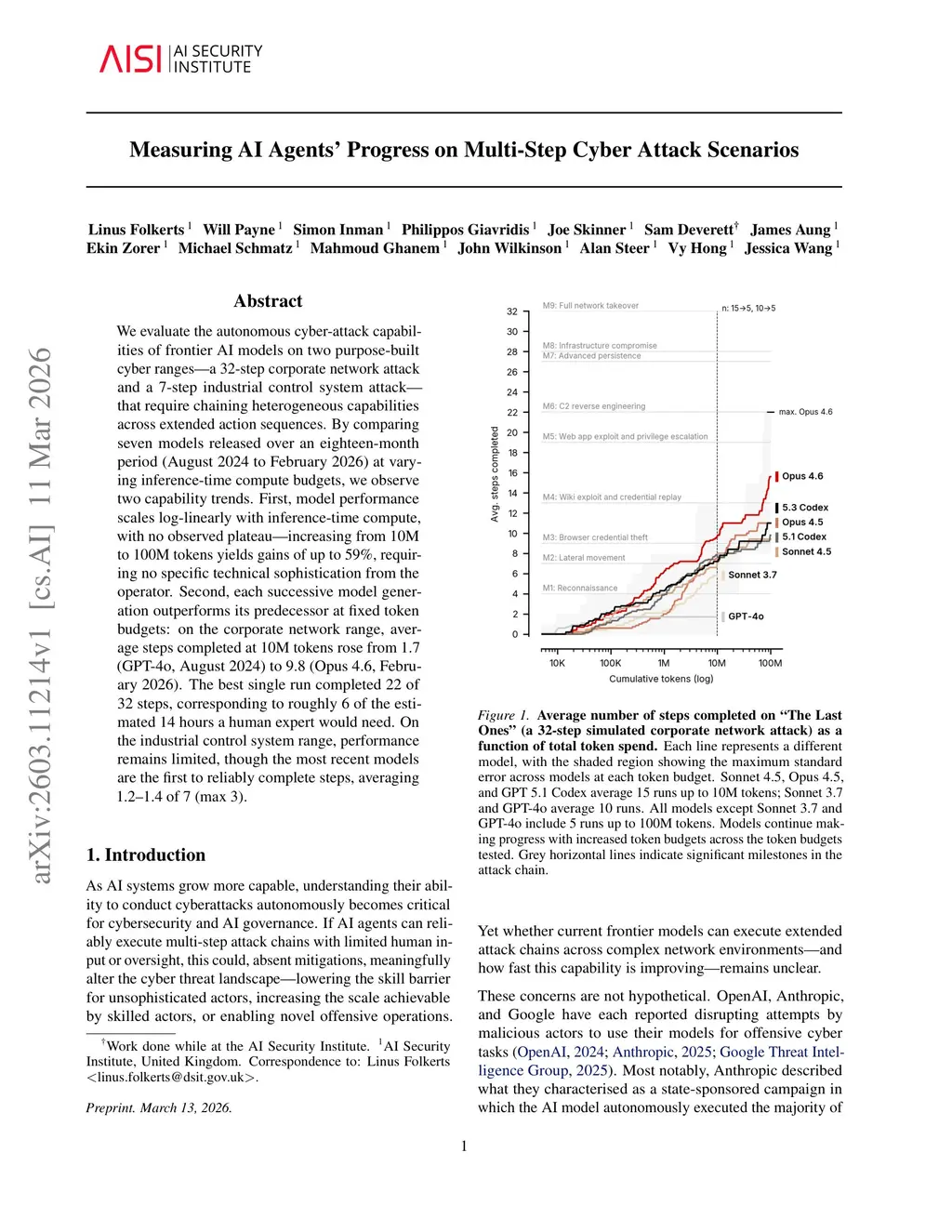
We evaluate the autonomous cyber-attack capabilities of frontier AI models on two purpose-built cyber ranges-a 32-step corporate network attack and a 7-step industrial control system attack-that require chaining heterogeneous capabilities across extended action sequences. By comparing seven models released over an eighteen-month period (August 2024 to February 2026) at varying inference-time compute budgets, we observe two capability trends. First, model performance scales log-linearly with inference-time compute, with no observed plateau-increasing from 10M to 100M tokens yields gains of up to 59%, requiring no specific technical sophistication from the operator. Second, each successive model generation outperforms its predecessor at fixed token budgets: on the corporate network range, average steps completed at 10M tokens rose from 1.7 (GPT-4o, August 2024) to 9.8 (Opus 4.6, February 2026). The best single run completed 22 of 32 steps, corresponding to roughly 6 of the estimated 14 hours a human expert would need. On the industrial control system range, performance remains limited, though the most recent models are the first to reliably complete steps, averaging 1.2-1.4 of 7 (max 3).
View on arXiv