
From Intuition to Investigation: A Tool-Augmented Reasoning MLLM Framework for Generalizable Face Anti-Spoofing
- CVBMLRM
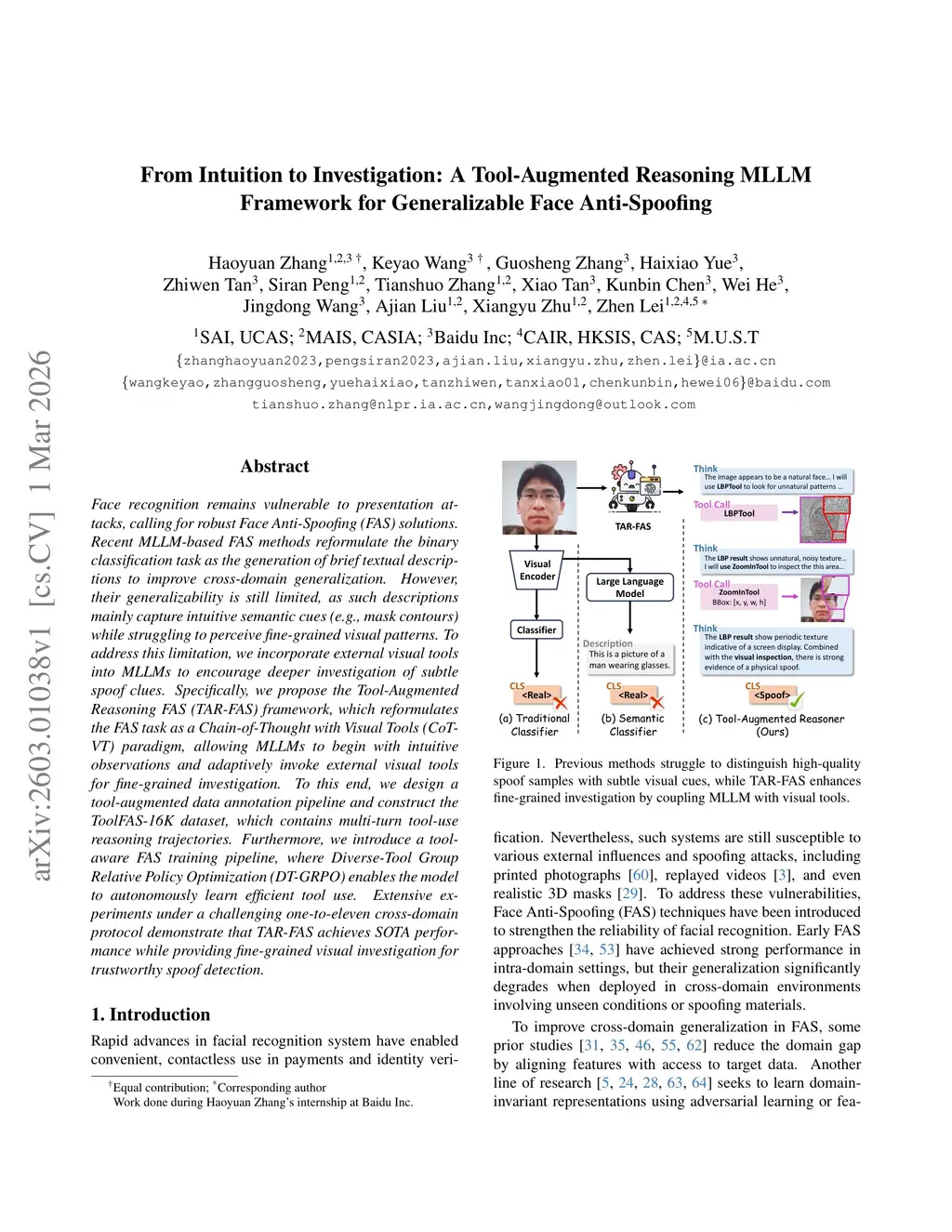
Face recognition remains vulnerable to presentation attacks, calling for robust Face Anti-Spoofing (FAS) solutions. Recent MLLM-based FAS methods reformulate the binary classification task as the generation of brief textual descriptions to improve cross-domain generalization. However, their generalizability is still limited, as such descriptions mainly capture intuitive semantic cues (e.g., mask contours) while struggling to perceive fine-grained visual patterns. To address this limitation, we incorporate external visual tools into MLLMs to encourage deeper investigation of subtle spoof clues. Specifically, we propose the Tool-Augmented Reasoning FAS (TAR-FAS) framework, which reformulates the FAS task as a Chain-of-Thought with Visual Tools (CoT-VT) paradigm, allowing MLLMs to begin with intuitive observations and adaptively invoke external visual tools for fine-grained investigation. To this end, we design a tool-augmented data annotation pipeline and construct the ToolFAS-16K dataset, which contains multi-turn tool-use reasoning trajectories. Furthermore, we introduce a tool-aware FAS training pipeline, where Diverse-Tool Group Relative Policy Optimization (DT-GRPO) enables the model to autonomously learn efficient tool use. Extensive experiments under a challenging one-to-eleven cross-domain protocol demonstrate that TAR-FAS achieves SOTA performance while providing fine-grained visual investigation for trustworthy spoof detection.
View on arXiv