
Suppressing Prior-Comparison Hallucinations in Radiology Report Generation via Semantically Decoupled Latent Steering
- LLMSV
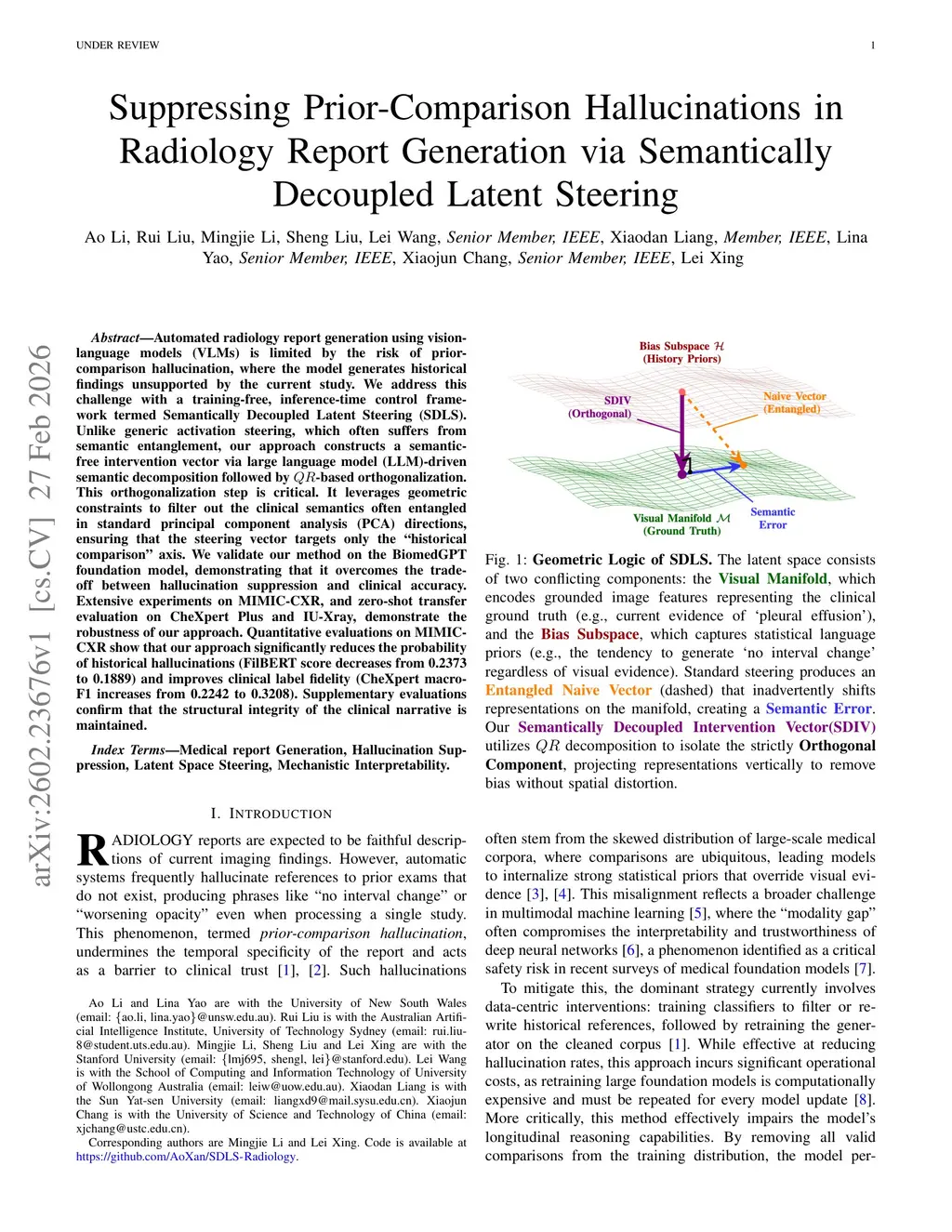
Automated radiology report generation using vision-language models (VLMs) is limited by the risk of prior-comparison hallucination, where the model generates historical findings unsupported by the current study. We address this challenge with a training-free, inference-time control framework termed Semantically Decoupled Latent Steering (SDLS). Unlike generic activation steering, which often suffers from semantic entanglement, our approach constructs a semantic-free intervention vector via large language model (LLM)-driven semantic decomposition followed by -based orthogonalization. This orthogonalization step is critical. It leverages geometric constraints to filter out the clinical semantics often entangled in standard principal component analysis (PCA) directions, ensuring that the steering vector targets only the ``historical comparison" axis. We validate our method on the BiomedGPT foundation model, demonstrating that it overcomes the trade-off between hallucination suppression and clinical accuracy. Extensive experiments on MIMIC-CXR, and zero-shot transfer evaluation on CheXpert Plus and IU-Xray, demonstrate the robustness of our approach. Quantitative evaluations on MIMIC-CXR show that our approach significantly reduces the probability of historical hallucinations (FilBERT score decreases from 0.2373 to 0.1889) and improves clinical label fidelity (CheXpert macro-F1 increases from 0.2242 to 0.3208). Supplementary evaluations confirm that the structural integrity of the clinical narrative is maintained.
View on arXiv