
Unbalanced optimal transport for robust longitudinal lesion evolution with registration-aware and appearance-guided priors
- OODMedIm
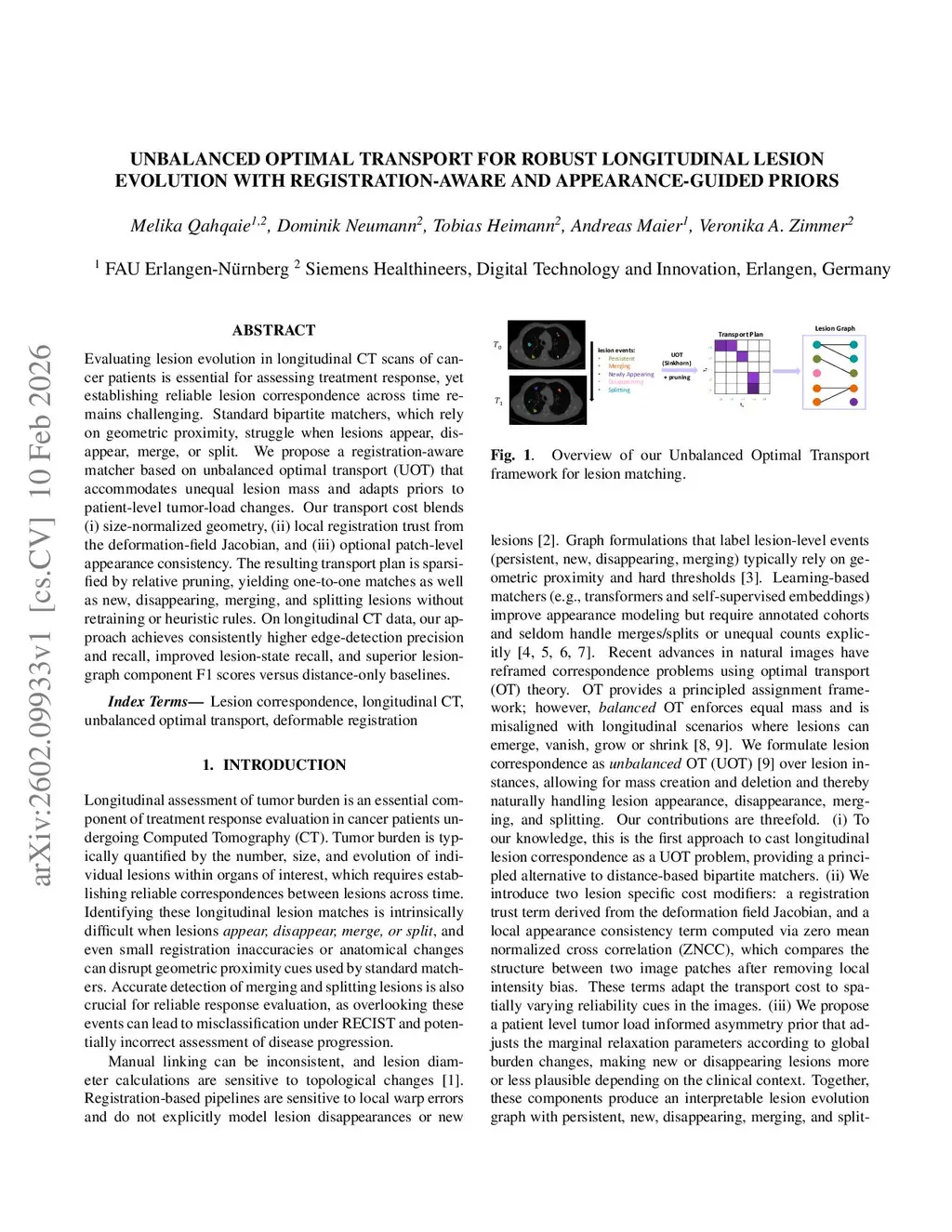
Evaluating lesion evolution in longitudinal CT scans of can cer patients is essential for assessing treatment response, yet establishing reliable lesion correspondence across time remains challenging. Standard bipartite matchers, which rely on geometric proximity, struggle when lesions appear, disappear, merge, or split. We propose a registration-aware matcher based on unbalanced optimal transport (UOT) that accommodates unequal lesion mass and adapts priors to patient-level tumor-load changes. Our transport cost blends (i) size-normalized geometry, (ii) local registration trust from the deformation-field Jacobian, and (iii) optional patch-level appearance consistency. The resulting transport plan is sparsified by relative pruning, yielding one-to-one matches as well as new, disappearing, merging, and splitting lesions without retraining or heuristic rules. On longitudinal CT data, our approach achieves consistently higher edge-detection precision and recall, improved lesion-state recall, and superior lesion-graph component F1 scores versus distance-only baselines.
View on arXiv