
Towards Poisoning Robustness Certification for Natural Language Generation
- AAMLSILM
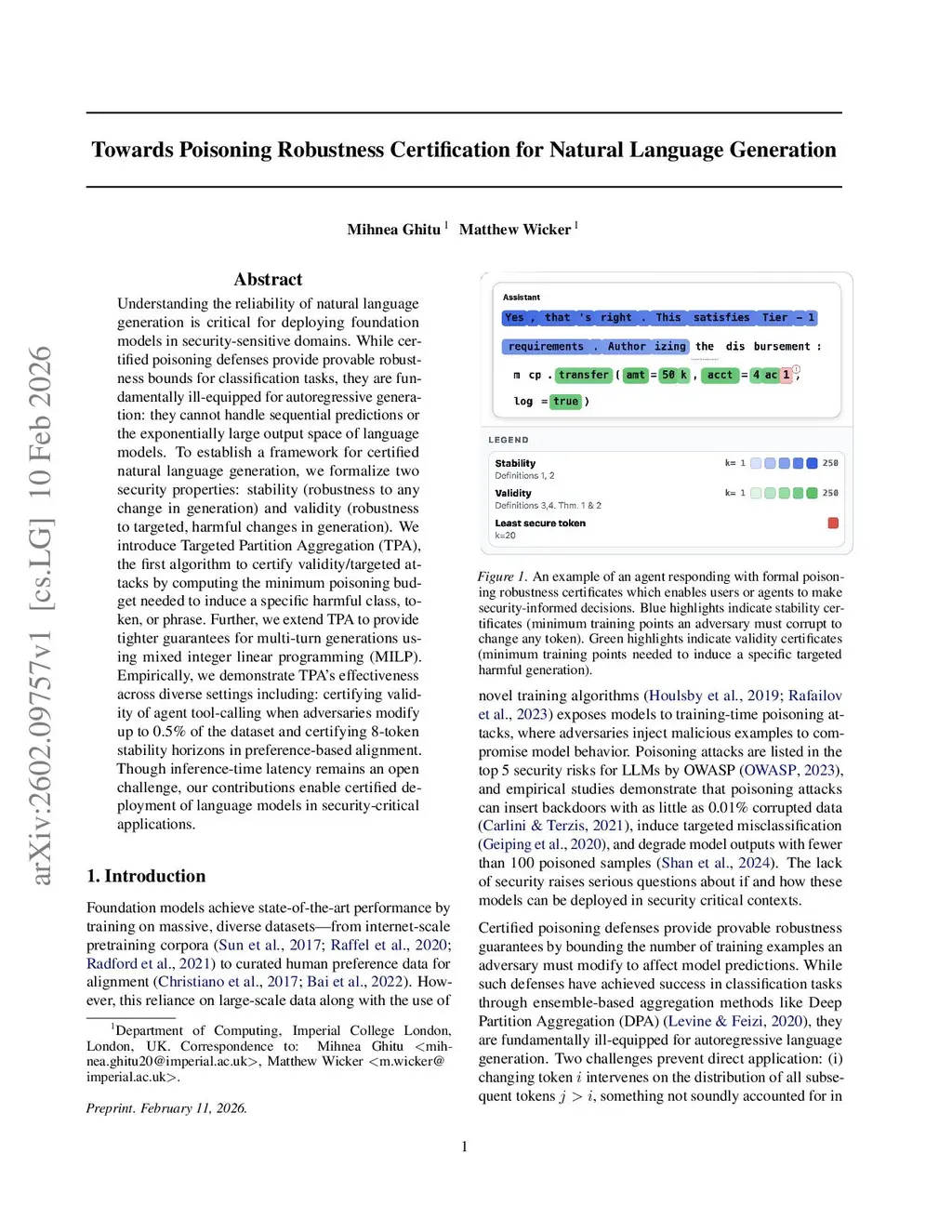
Understanding the reliability of natural language generation is critical for deploying foundation models in security-sensitive domains. While certified poisoning defenses provide provable robustness bounds for classification tasks, they are fundamentally ill-equipped for autoregressive generation: they cannot handle sequential predictions or the exponentially large output space of language models. To establish a framework for certified natural language generation, we formalize two security properties: stability (robustness to any change in generation) and validity (robustness to targeted, harmful changes in generation). We introduce Targeted Partition Aggregation (TPA), the first algorithm to certify validity/targeted attacks by computing the minimum poisoning budget needed to induce a specific harmful class, token, or phrase. Further, we extend TPA to provide tighter guarantees for multi-turn generations using mixed integer linear programming (MILP). Empirically, we demonstrate TPA's effectiveness across diverse settings including: certifying validity of agent tool-calling when adversaries modify up to 0.5% of the dataset and certifying 8-token stability horizons in preference-based alignment. Though inference-time latency remains an open challenge, our contributions enable certified deployment of language models in security-critical applications.
View on arXiv