
ReBeCA: Unveiling Interpretable Behavior Hierarchy behind the Iterative Self-Reflection of Language Models with Causal Analysis
- CML
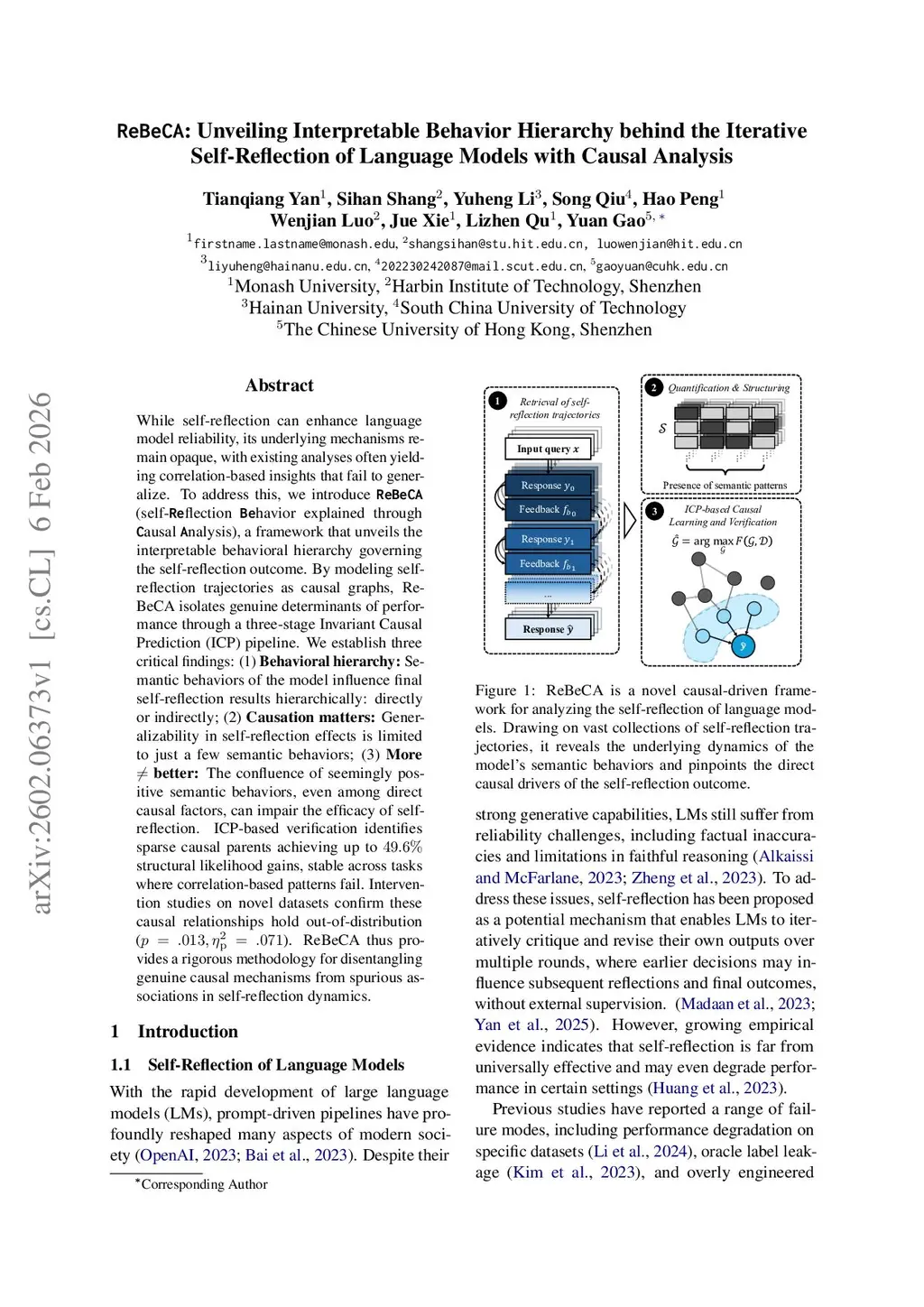
While self-reflection can enhance language model reliability, its underlying mechanisms remain opaque, with existing analyses often yielding correlation-based insights that fail to generalize. To address this, we introduce \textbf{\texttt{ReBeCA}} (self-\textbf{\texttt{Re}}flection \textbf{\texttt{Be}}havior explained through \textbf{\texttt{C}}ausal \textbf{\texttt{A}}nalysis), a framework that unveils the interpretable behavioral hierarchy governing the self-reflection outcome. By modeling self-reflection trajectories as causal graphs, ReBeCA isolates genuine determinants of performance through a three-stage Invariant Causal Prediction (ICP) pipeline. We establish three critical findings: (1) \textbf{Behavioral hierarchy:} Semantic behaviors of the model influence final self-reflection results hierarchically: directly or indirectly; (2) \textbf{Causation matters:} Generalizability in self-reflection effects is limited to just a few semantic behaviors; (3) \textbf{More better:} The confluence of seemingly positive semantic behaviors, even among direct causal factors, can impair the efficacy of self-reflection. ICP-based verification identifies sparse causal parents achieving up to structural likelihood gains, stable across tasks where correlation-based patterns fail. Intervention studies on novel datasets confirm these causal relationships hold out-of-distribution (). ReBeCA thus provides a rigorous methodology for disentangling genuine causal mechanisms from spurious associations in self-reflection dynamics.
View on arXiv