
PISCES: Annotation-free Text-to-Video Post-Training via Optimal Transport-Aligned Rewards
- VGen
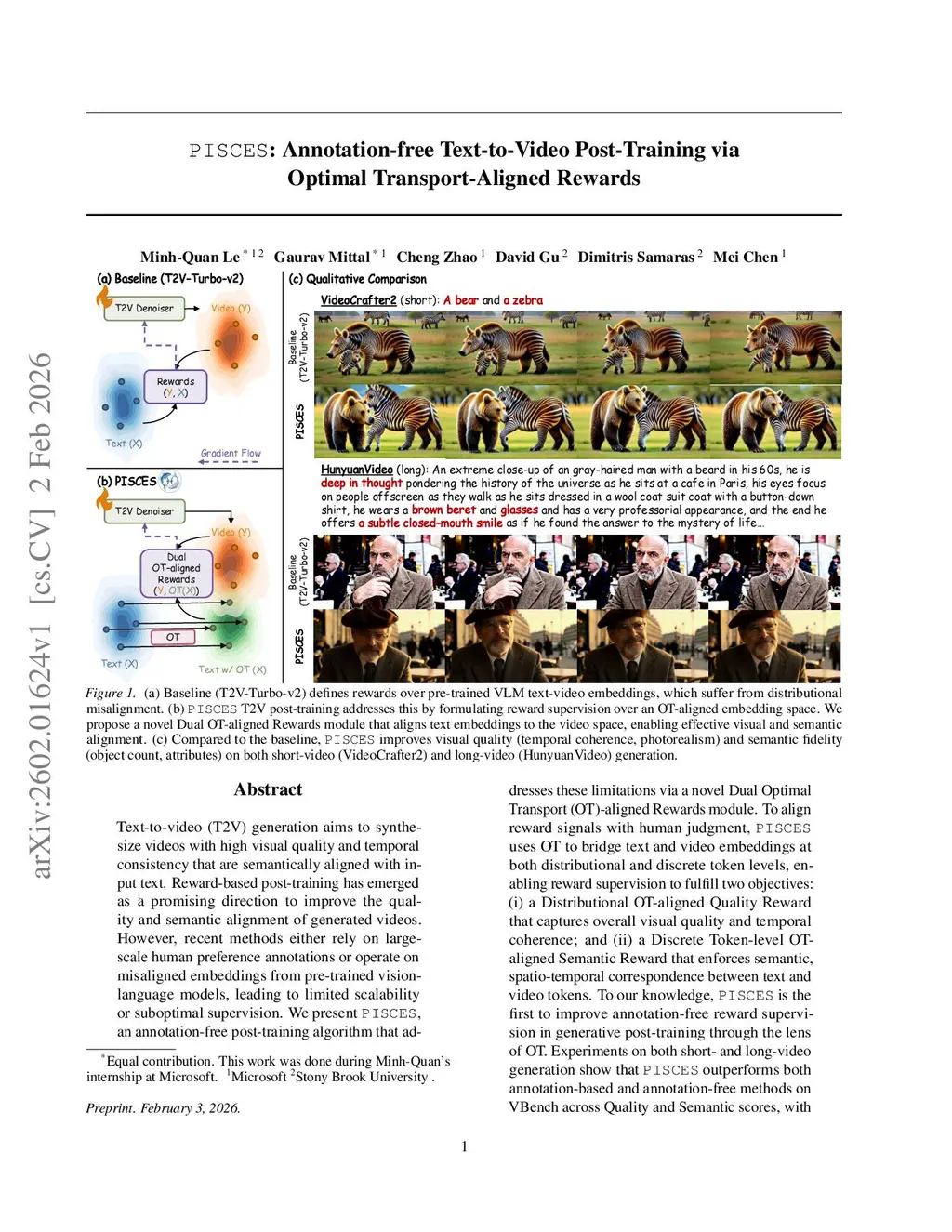
Text-to-video (T2V) generation aims to synthesize videos with high visual quality and temporal consistency that are semantically aligned with input text. Reward-based post-training has emerged as a promising direction to improve the quality and semantic alignment of generated videos. However, recent methods either rely on large-scale human preference annotations or operate on misaligned embeddings from pre-trained vision-language models, leading to limited scalability or suboptimal supervision. We present , an annotation-free post-training algorithm that addresses these limitations via a novel Dual Optimal Transport (OT)-aligned Rewards module. To align reward signals with human judgment, uses OT to bridge text and video embeddings at both distributional and discrete token levels, enabling reward supervision to fulfill two objectives: (i) a Distributional OT-aligned Quality Reward that captures overall visual quality and temporal coherence; and (ii) a Discrete Token-level OT-aligned Semantic Reward that enforces semantic, spatio-temporal correspondence between text and video tokens. To our knowledge, is the first to improve annotation-free reward supervision in generative post-training through the lens of OT. Experiments on both short- and long-video generation show that outperforms both annotation-based and annotation-free methods on VBench across Quality and Semantic scores, with human preference studies further validating its effectiveness. We show that the Dual OT-aligned Rewards module is compatible with multiple optimization paradigms, including direct backpropagation and reinforcement learning fine-tuning.
View on arXiv