
When Classes Evolve: A Benchmark and Framework for Stage-Aware Class-Incremental Learning
- CLL
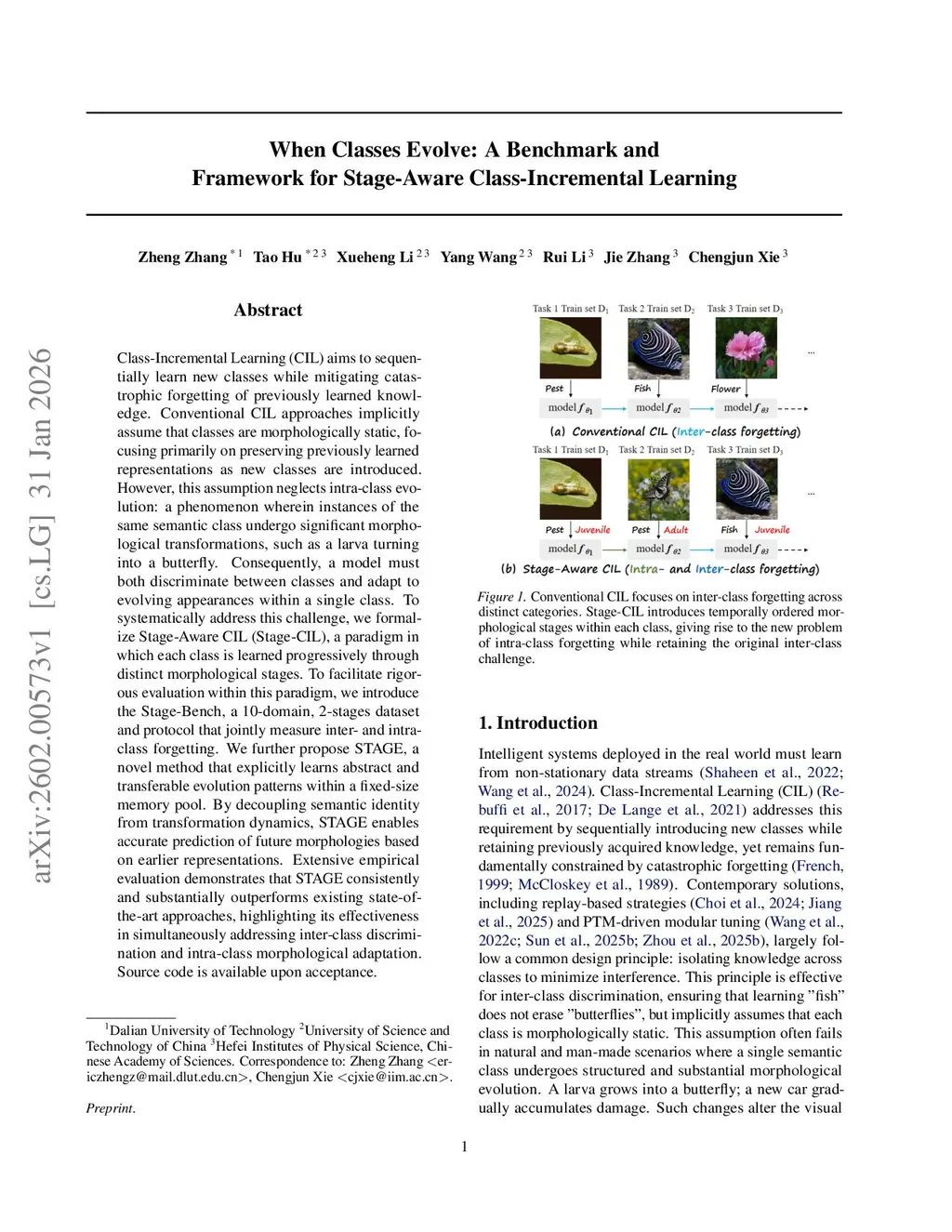
Class-Incremental Learning (CIL) aims to sequentially learn new classes while mitigating catastrophic forgetting of previously learned knowledge. Conventional CIL approaches implicitly assume that classes are morphologically static, focusing primarily on preserving previously learned representations as new classes are introduced. However, this assumption neglects intra-class evolution: a phenomenon wherein instances of the same semantic class undergo significant morphological transformations, such as a larva turning into a butterfly. Consequently, a model must both discriminate between classes and adapt to evolving appearances within a single class. To systematically address this challenge, we formalize Stage-Aware CIL (Stage-CIL), a paradigm in which each class is learned progressively through distinct morphological stages. To facilitate rigorous evaluation within this paradigm, we introduce the Stage-Bench, a 10-domain, 2-stages dataset and protocol that jointly measure inter- and intra-class forgetting. We further propose STAGE, a novel method that explicitly learns abstract and transferable evolution patterns within a fixed-size memory pool. By decoupling semantic identity from transformation dynamics, STAGE enables accurate prediction of future morphologies based on earlier representations. Extensive empirical evaluation demonstrates that STAGE consistently and substantially outperforms existing state-of-the-art approaches, highlighting its effectiveness in simultaneously addressing inter-class discrimination and intra-class morphological adaptation.
View on arXiv