
EDU-CIRCUIT-HW: Evaluating Multimodal Large Language Models on Real-World University-Level STEM Student Handwritten Solutions
- AI4EdELM
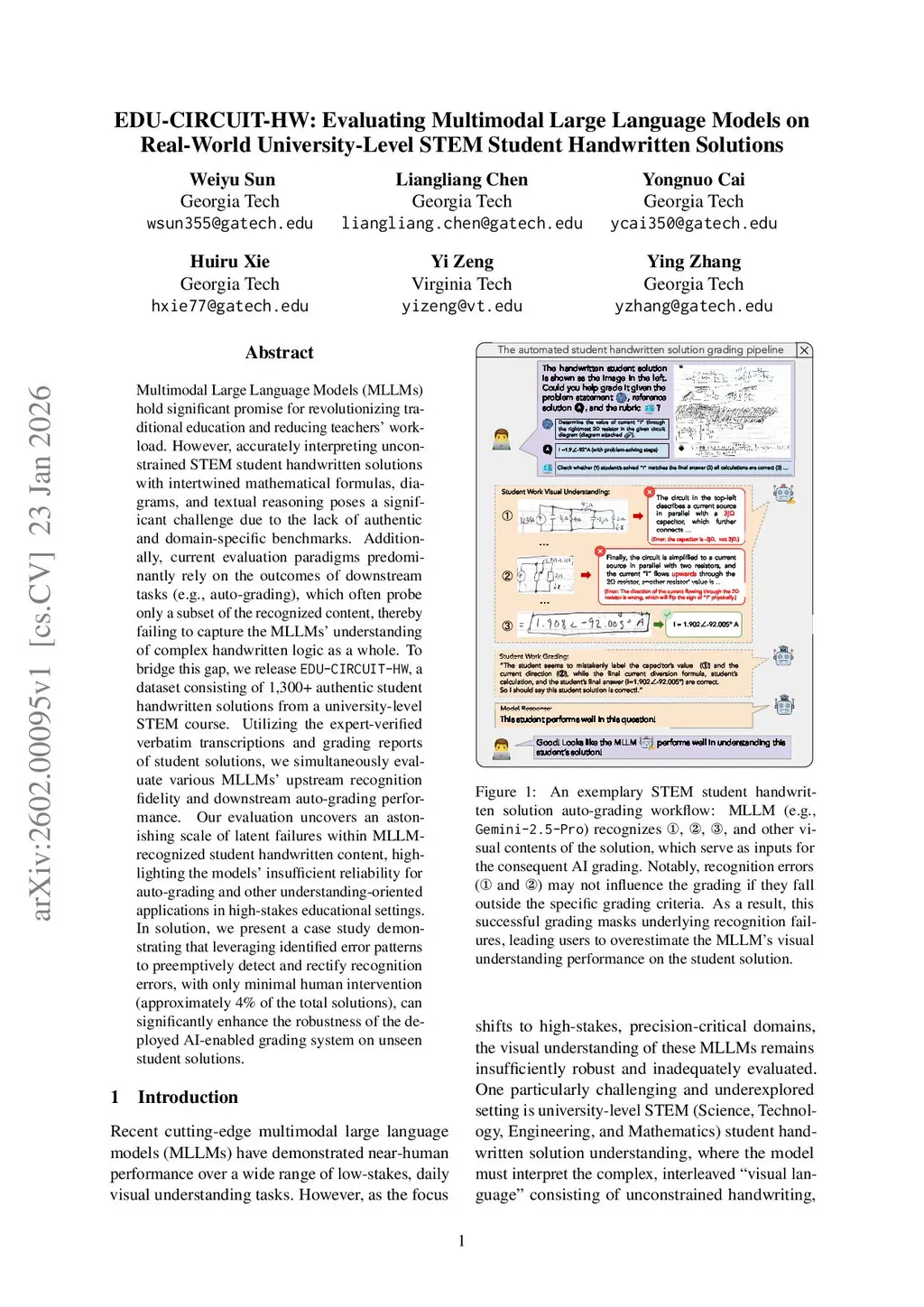
Multimodal Large Language Models (MLLMs) hold significant promise for revolutionizing traditional education and reducing teachers' workload. However, accurately interpreting unconstrained STEM student handwritten solutions with intertwined mathematical formulas, diagrams, and textual reasoning poses a significant challenge due to the lack of authentic and domain-specific benchmarks. Additionally, current evaluation paradigms predominantly rely on the outcomes of downstream tasks (e.g., auto-grading), which often probe only a subset of the recognized content, thereby failing to capture the MLLMs' understanding of complex handwritten logic as a whole. To bridge this gap, we release EDU-CIRCUIT-HW, a dataset consisting of 1,300+ authentic student handwritten solutions from a university-level STEM course. Utilizing the expert-verified verbatim transcriptions and grading reports of student solutions, we simultaneously evaluate various MLLMs' upstream recognition fidelity and downstream auto-grading performance. Our evaluation uncovers an astonishing scale of latent failures within MLLM-recognized student handwritten content, highlighting the models' insufficient reliability for auto-grading and other understanding-oriented applications in high-stakes educational settings. In solution, we present a case study demonstrating that leveraging identified error patterns to preemptively detect and rectify recognition errors, with only minimal human intervention (e.g., with 3.3% assignments routed to human graders while the rest to GPT-5.1 grader), can effectively enhance the robustness of the deployed AI-enabled grading system on unseen student solutions.
View on arXiv