
Is Training Necessary for Anomaly Detection?
- AAML
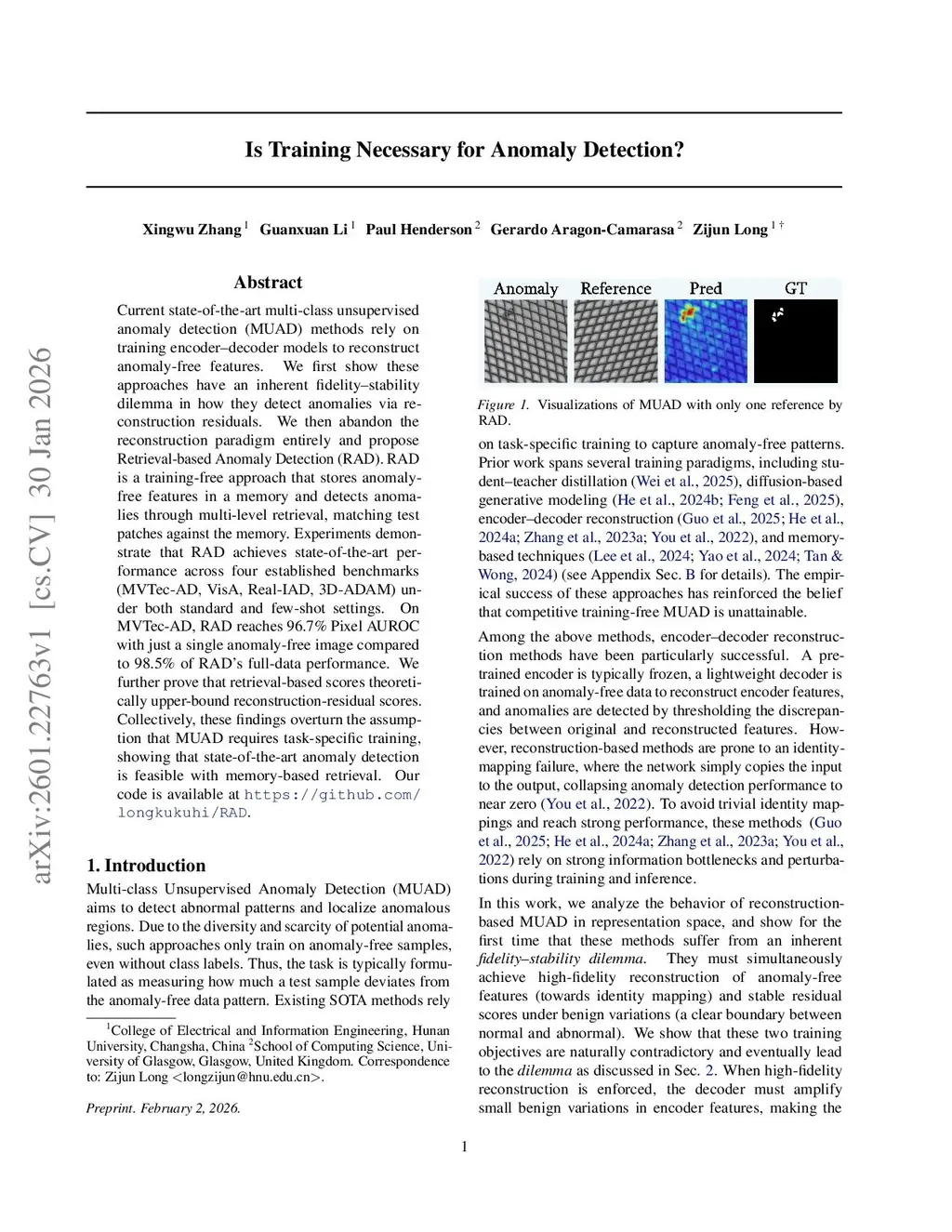
Current state-of-the-art multi-class unsupervised anomaly detection (MUAD) methods rely on training encoder-decoder models to reconstruct anomaly-free features. We first show these approaches have an inherent fidelity-stability dilemma in how they detect anomalies via reconstruction residuals. We then abandon the reconstruction paradigm entirely and propose Retrieval-based Anomaly Detection (RAD). RAD is a training-free approach that stores anomaly-free features in a memory and detects anomalies through multi-level retrieval, matching test patches against the memory. Experiments demonstrate that RAD achieves state-of-the-art performance across four established benchmarks (MVTec-AD, VisA, Real-IAD, 3D-ADAM) under both standard and few-shot settings. On MVTec-AD, RAD reaches 96.7\% Pixel AUROC with just a single anomaly-free image compared to 98.5\% of RAD's full-data performance. We further prove that retrieval-based scores theoretically upper-bound reconstruction-residual scores. Collectively, these findings overturn the assumption that MUAD requires task-specific training, showing that state-of-the-art anomaly detection is feasible with memory-based retrieval. Our code is available atthis https URL.
View on arXiv