
Better as Generators Than Classifiers: Leveraging LLMs and Synthetic Data for Low-Resource Multilingual Classification
- SyDa
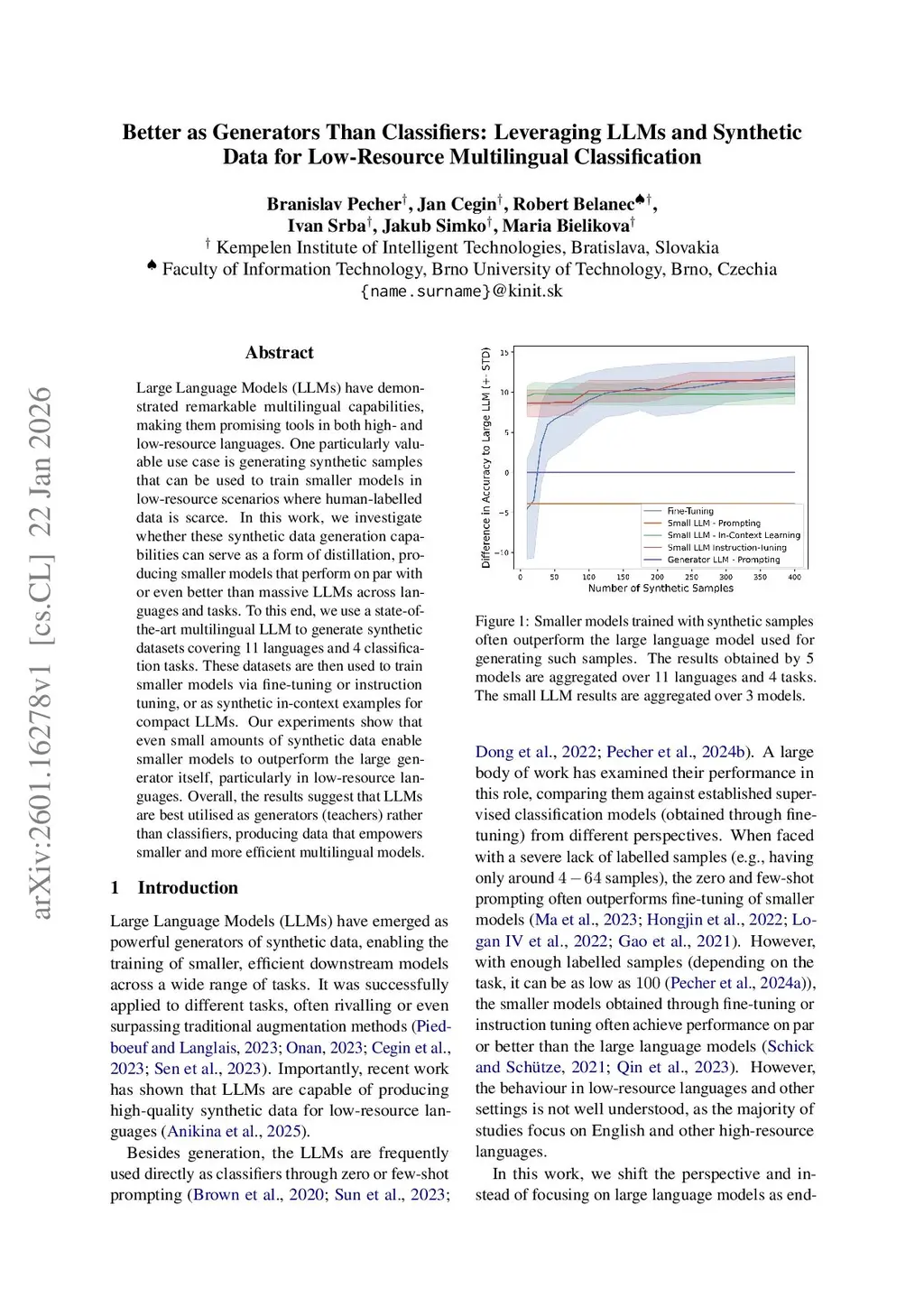
Large Language Models (LLMs) have demonstrated remarkable multilingual capabilities, making them promising tools in both high- and low-resource languages. One particularly valuable use case is generating synthetic samples that can be used to train smaller models in low-resource scenarios where human-labelled data is scarce. In this work, we investigate whether these synthetic data generation capabilities can serve as a form of distillation, producing smaller models that perform on par with or even better than massive LLMs across languages and tasks. To this end, we use a state-of-the-art multilingual LLM to generate synthetic datasets covering 11 languages and 4 classification tasks. These datasets are then used to train smaller models via fine-tuning or instruction tuning, or as synthetic in-context examples for compact LLMs. Our experiments show that even small amounts of synthetic data enable smaller models to outperform the large generator itself, particularly in low-resource languages. Overall, the results suggest that LLMs are best utilised as generators (teachers) rather than classifiers, producing data that empowers smaller and more efficient multilingual models.
View on arXiv