
PASs-MoE: Mitigating Misaligned Co-drift among Router and Experts via Pathway Activation Subspaces for Continual Learning
- MoEMoMe
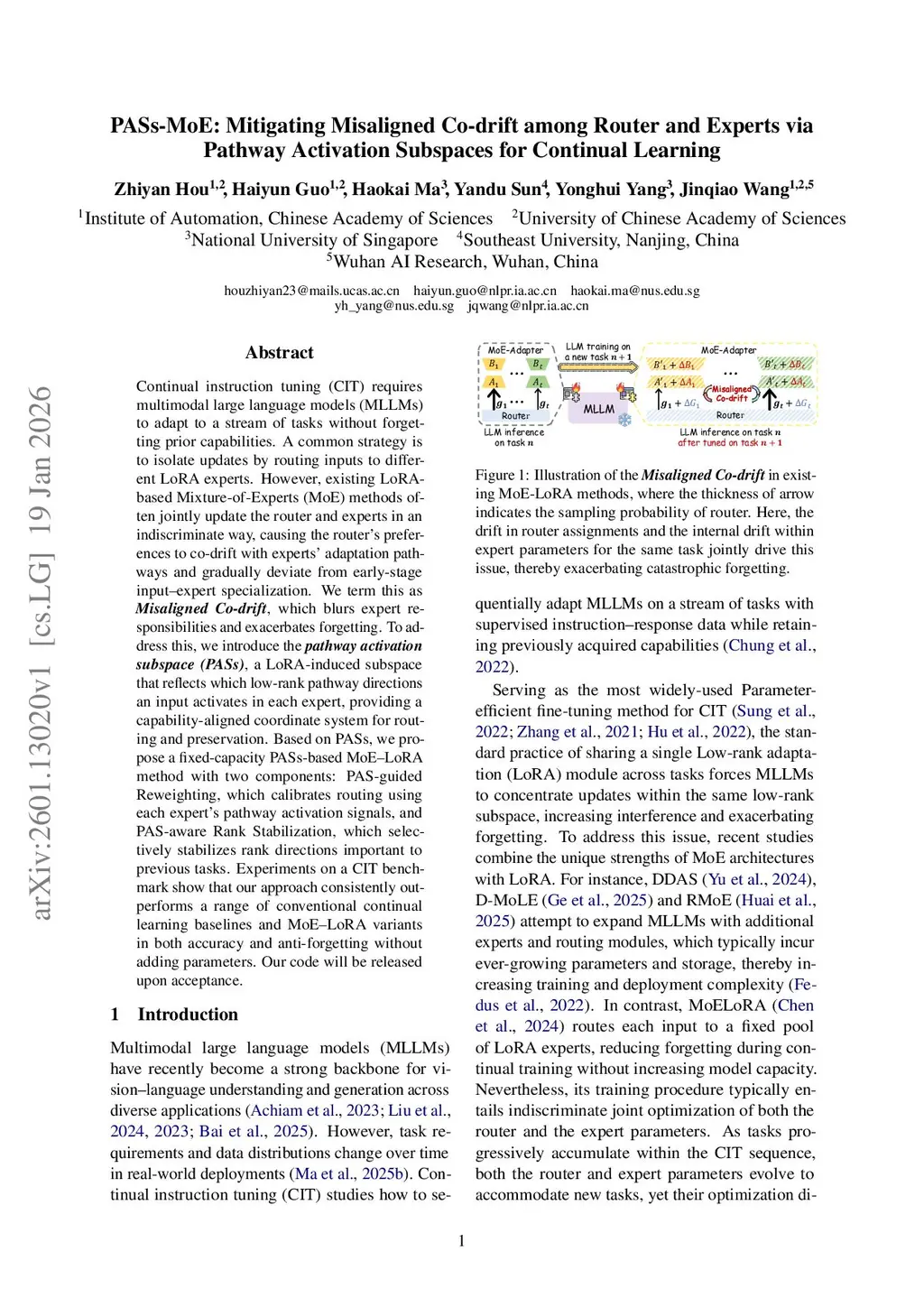
Continual instruction tuning (CIT) requires multimodal large language models (MLLMs) to adapt to a stream of tasks without forgetting prior capabilities. A common strategy is to isolate updates by routing inputs to different LoRA experts. However, existing LoRA-based Mixture-of-Experts (MoE) methods often jointly update the router and experts in an indiscriminate way, causing the router's preferences to co-drift with experts' adaptation pathways and gradually deviate from early-stage input-expert specialization. We term this phenomenon Misaligned Co-drift, which blurs expert responsibilities and exacerbatesthis http URLaddress this, we introduce the pathway activation subspace (PASs), a LoRA-induced subspace that reflects which low-rank pathway directions an input activates in each expert, providing a capability-aligned coordinate system for routing and preservation. Based on PASs, we propose a fixed-capacity PASs-based MoE-LoRA method with two components: PAS-guided Reweighting, which calibrates routing using each expert's pathway activation signals, and PAS-aware Rank Stabilization, which selectively stabilizes rank directions important to previous tasks. Experiments on a CIT benchmark show that our approach consistently outperforms a range of conventional continual learning baselines and MoE-LoRA variants in both accuracy and anti-forgetting without adding parameters. Our code will be released upon acceptance.
View on arXiv