
Learning Geometric Invariance for Gait Recognition
- CVBMSLR
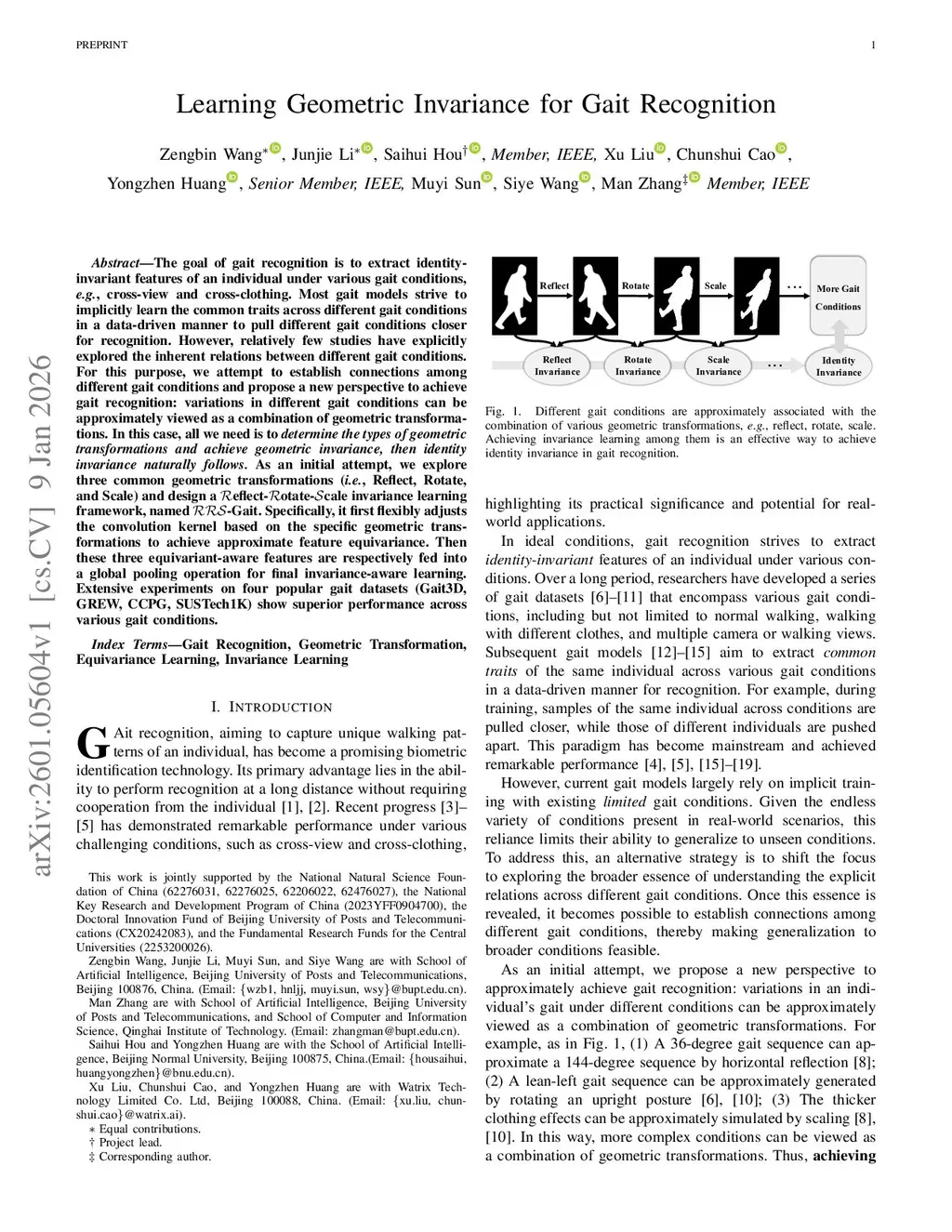
The goal of gait recognition is to extract identity-invariant features of an individual under various gait conditions, e.g., cross-view and cross-clothing. Most gait models strive to implicitly learn the common traits across different gait conditions in a data-driven manner to pull different gait conditions closer for recognition. However, relatively few studies have explicitly explored the inherent relations between different gait conditions. For this purpose, we attempt to establish connections among different gait conditions and propose a new perspective to achieve gait recognition: variations in different gait conditions can be approximately viewed as a combination of geometric transformations. In this case, all we need is to determine the types of geometric transformations and achieve geometric invariance, then identity invariance naturally follows. As an initial attempt, we explore three common geometric transformations (i.e., Reflect, Rotate, and Scale) and design a eflect-otate-cale invariance learning framework, named -Gait. Specifically, it first flexibly adjusts the convolution kernel based on the specific geometric transformations to achieve approximate feature equivariance. Then these three equivariant-aware features are respectively fed into a global pooling operation for final invariance-aware learning. Extensive experiments on four popular gait datasets (Gait3D, GREW, CCPG, SUSTech1K) show superior performance across various gait conditions.
View on arXiv