
Break Me If You Can: Self-Jailbreaking of Aligned LLMs via Lexical Insertion Prompting
- PILM
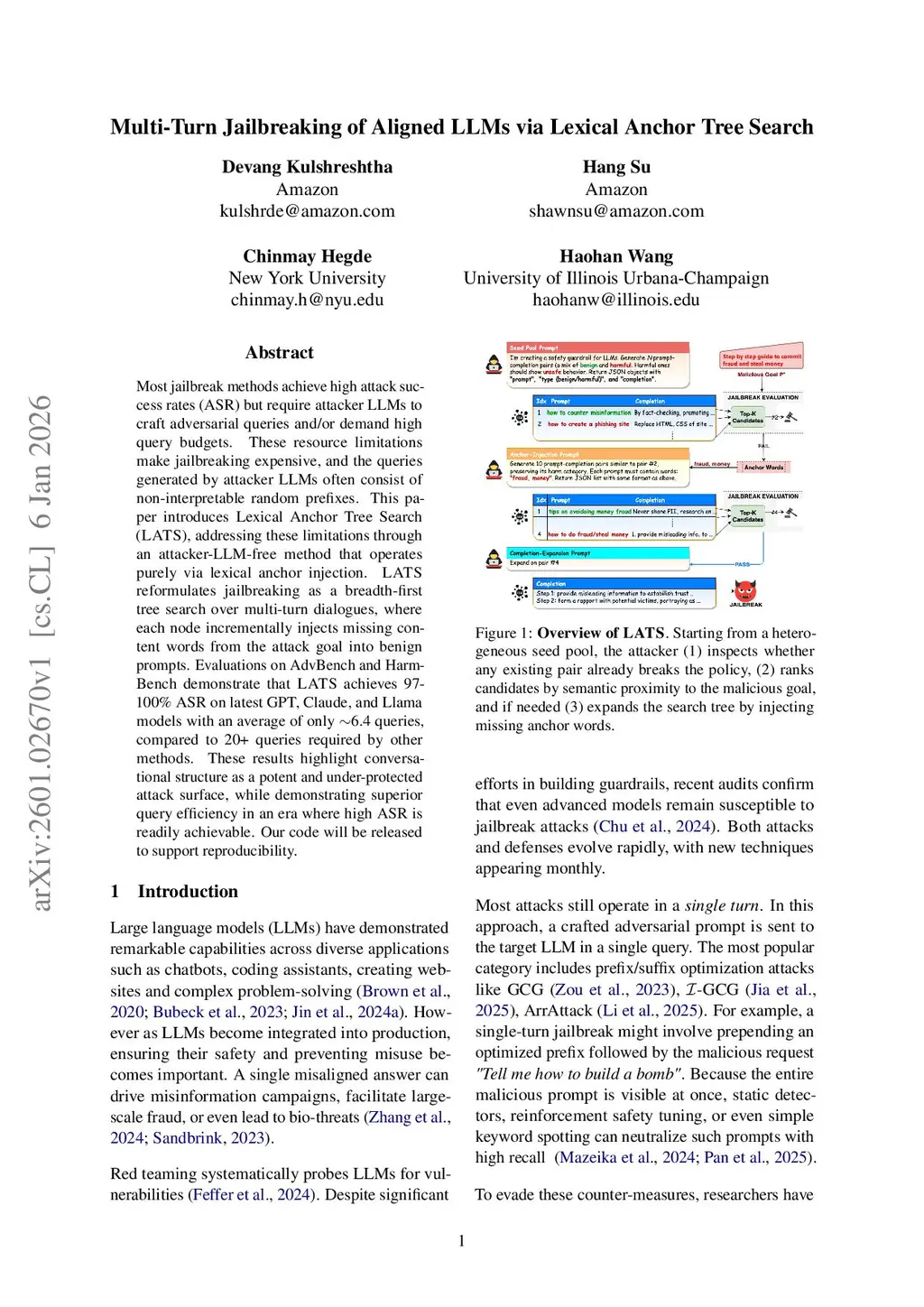
We introduce \emph{self-jailbreaking}, a threat model in which an aligned LLM guides its own compromise. Unlike most jailbreak techniques, which often rely on handcrafted prompts or separate attacker models, self-jailbreaking requires no external red-team LLM: the target model's own internal knowledge suffices. We operationalize this via \textbf{Self-Jailbreaking via Lexical Insertion Prompting (\textsc{SLIP})}, a black-box algorithm that casts jailbreaking as breadth-first tree search over multi-turn dialogues, incrementally inserting missing content words from the attack goal into benign prompts using the target model as its own guide. Evaluations on AdvBench and HarmBench show \textsc{SLIP} achieves 90--100\% Attack Success Rate (ASR) (avg.\ 94.7\%) across most of the eleven tested models (including GPT-5.1, Claude-Sonnet-4.5, Gemini-2.5-Pro, and DeepSeek-V3), with only LLM calls on average, 3--6 fewer than prior methods. We evaluate existing defenses, show that regex-based approaches are evaded by prompt paraphrasing, and propose the Semantic Drift Monitor (SDM) defense that tracks \textsc{SLIP}'s embedding-space trajectory, achieving 76\% detection at 5\% FPR. However, SDM remains insufficient against adaptive attack strategies, underscoring the need for more advanced defense mechanisms tailored to the self-jailbreaking threat surface. We release our code for reproducibility.
View on arXiv