
Grading Handwritten Engineering Exams with Multimodal Large Language Models
- AI4Ed
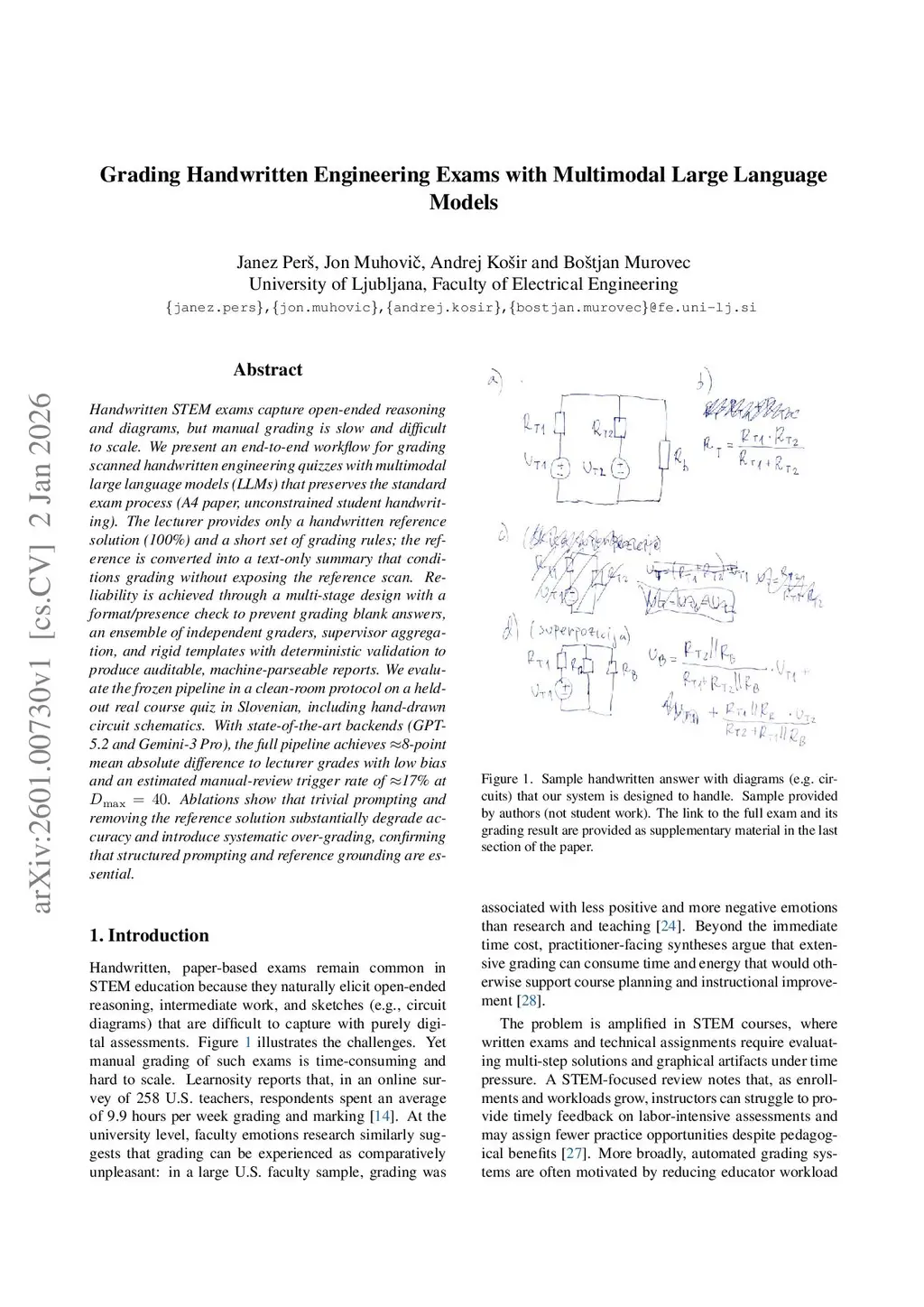
Handwritten STEM exams capture open-ended reasoning and diagrams, but manual grading is slow and difficult to scale. We present an end-to-end workflow for grading scanned handwritten engineering quizzes with multimodal large language models (LLMs) that preserves the standard exam process (A4 paper, unconstrained student handwriting). The lecturer provides only a handwritten reference solution (100%) and a short set of grading rules; the reference is converted into a text-only summary that conditions grading without exposing the reference scan. Reliability is achieved through a multi-stage design with a format/presence check to prevent grading blank answers, an ensemble of independent graders, supervisor aggregation, and rigid templates with deterministic validation to produce auditable, machine-parseable reports. We evaluate the frozen pipeline in a clean-room protocol on a held-out real course quiz in Slovenian, including hand-drawn circuit schematics. With state-of-the-art backends (GPT-5.2 and Gemini-3 Pro), the full pipeline achieves 8-point mean absolute difference to lecturer grades with low bias and an estimated manual-review trigger rate of 17% at . Ablations show that trivial prompting and removing the reference solution substantially degrade accuracy and introduce systematic over-grading, confirming that structured prompting and reference grounding are essential.
View on arXiv