
A Machine Learning Perspective on Automated Driving Corner Cases
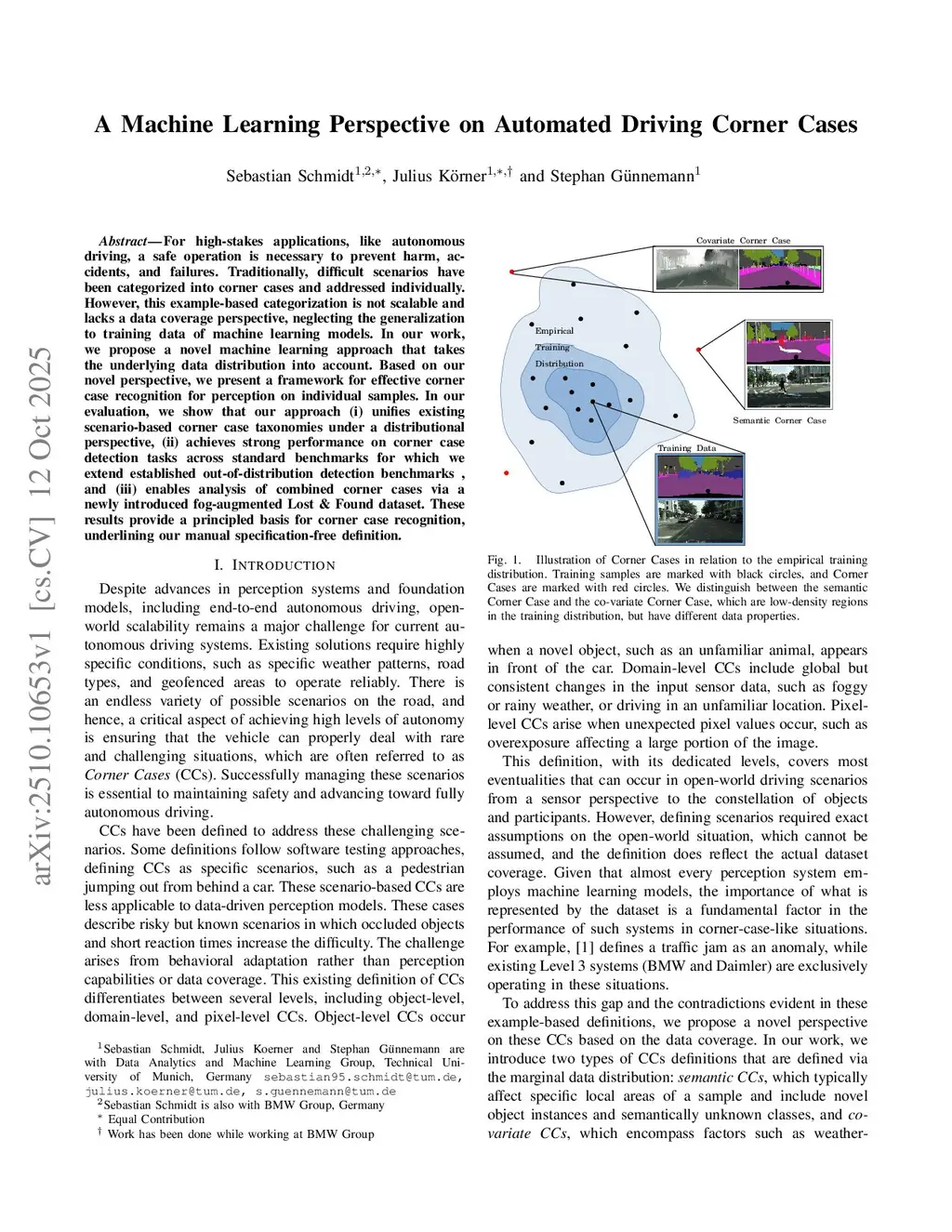
For high-stakes applications, like autonomous driving, a safe operation is necessary to prevent harm, accidents, and failures. Traditionally, difficult scenarios have been categorized into corner cases and addressed individually. However, this example-based categorization is not scalable and lacks a data coverage perspective, neglecting the generalization to training data of machine learning models. In our work, we propose a novel machine learning approach that takes the underlying data distribution into account. Based on our novel perspective, we present a framework for effective corner case recognition for perception on individual samples. In our evaluation, we show that our approach (i) unifies existing scenario-based corner case taxonomies under a distributional perspective, (ii) achieves strong performance on corner case detection tasks across standard benchmarks for which we extend established out-of-distribution detection benchmarks, and (iii) enables analysis of combined corner cases via a newly introduced fog-augmented Lost & Found dataset. These results provide a principled basis for corner case recognition, underlining our manual specification-free definition.
View on arXiv