All Papers
0 / 0 papers shown
Title |
|---|

Title |
|---|
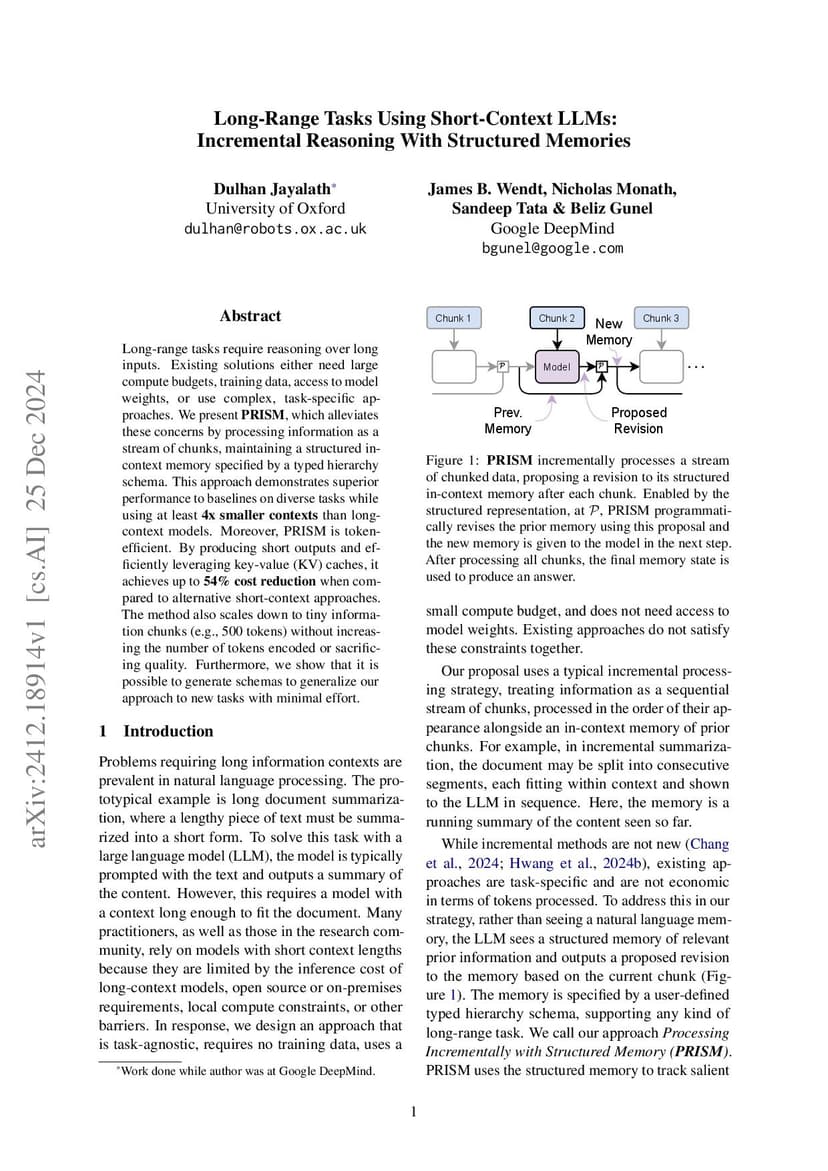
Long-range tasks demand reasoning over long inputs. However, existing solutions are limited, e.g., long-context models require large compute budgets, parameter-efficient fine-tuning (PEFT) needs training data, and retrieval-augmented generation (RAG) entails complex task-specific designs. Though in-context approaches overcome many of these issues, methods with short-context LLMs are inefficient, trading context for processing more tokens. We introduce PRISM, a highly token-efficient in-context method based on structured schemas that outperforms baselines on diverse tasks with 4x shorter contexts. This approach produces concise outputs and efficiently leverages key-value (KV) caches to reduce costs by up to 54%. PRISM scales down to tiny contexts without increasing costs or sacrificing quality, and generalizes to new tasks with minimal effort by generating schemas from task descriptions.
View on arXiv