
Event-Based Simulation of Stochastic Memristive Devices for Neuromorphic Computing
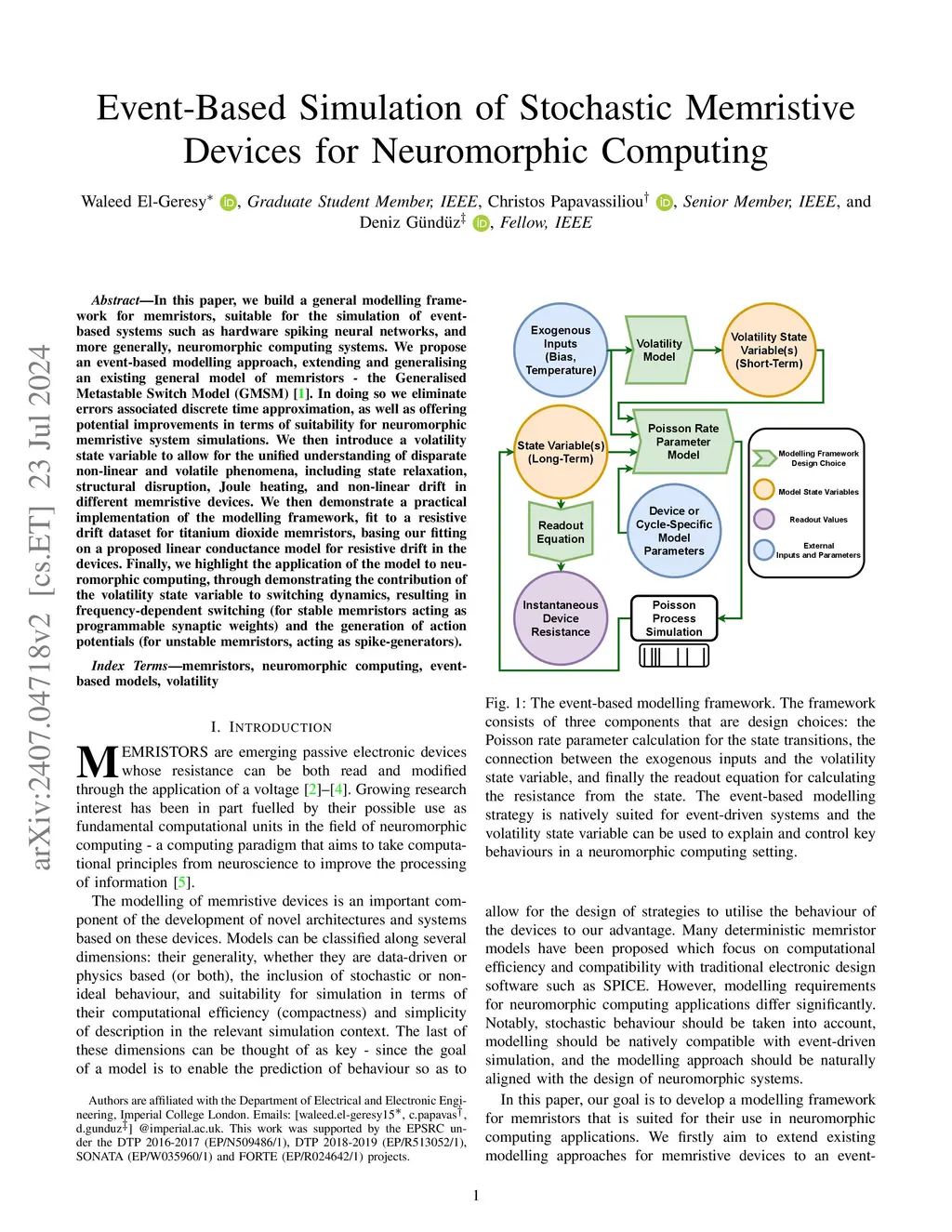
In this paper, we build a general modelling framework for memristors, suitable for the simulation of event-based systems such as hardware spiking neural networks, and more generally, neuromorphic computing systems composed of three independent components: i) an event-based modelling approach, extending and generalising an existing general model of memristors - the Generalised Metastable Switch Model (GMSM) - eliminating errors associated with discrete time approximation, as well as offering potential improvements in terms of suitability for neuromorphic memristive system simulations; ii) a volatility state variable to allow for the unified understanding of disparate non-linear and volatile phenomena, including state relaxation, structural disruption, Joule heating, and non-linear drift in different memristive devices; and iii) a readout equation that separates the latent state variable evolution from explicit variables of interest such as an instantaneous resistance. We exhibit an illustrative implementation of this framework, fit to a resistive drift dataset for titanium dioxide memristors, based on a proposed linear conductance model for resistive drift in the devices. Finally, we highlight the application of the model to neuromorphic computing, through demonstrating the contribution of the volatility state variable to switching dynamics, resulting in frequency-dependent switching (for stable memristors acting as programmable synaptic weights) and the generation of action potentials (for unstable memristors, acting as spike-generators).
View on arXiv