
Fine-Grained Domain Generalization with Feature Structuralization
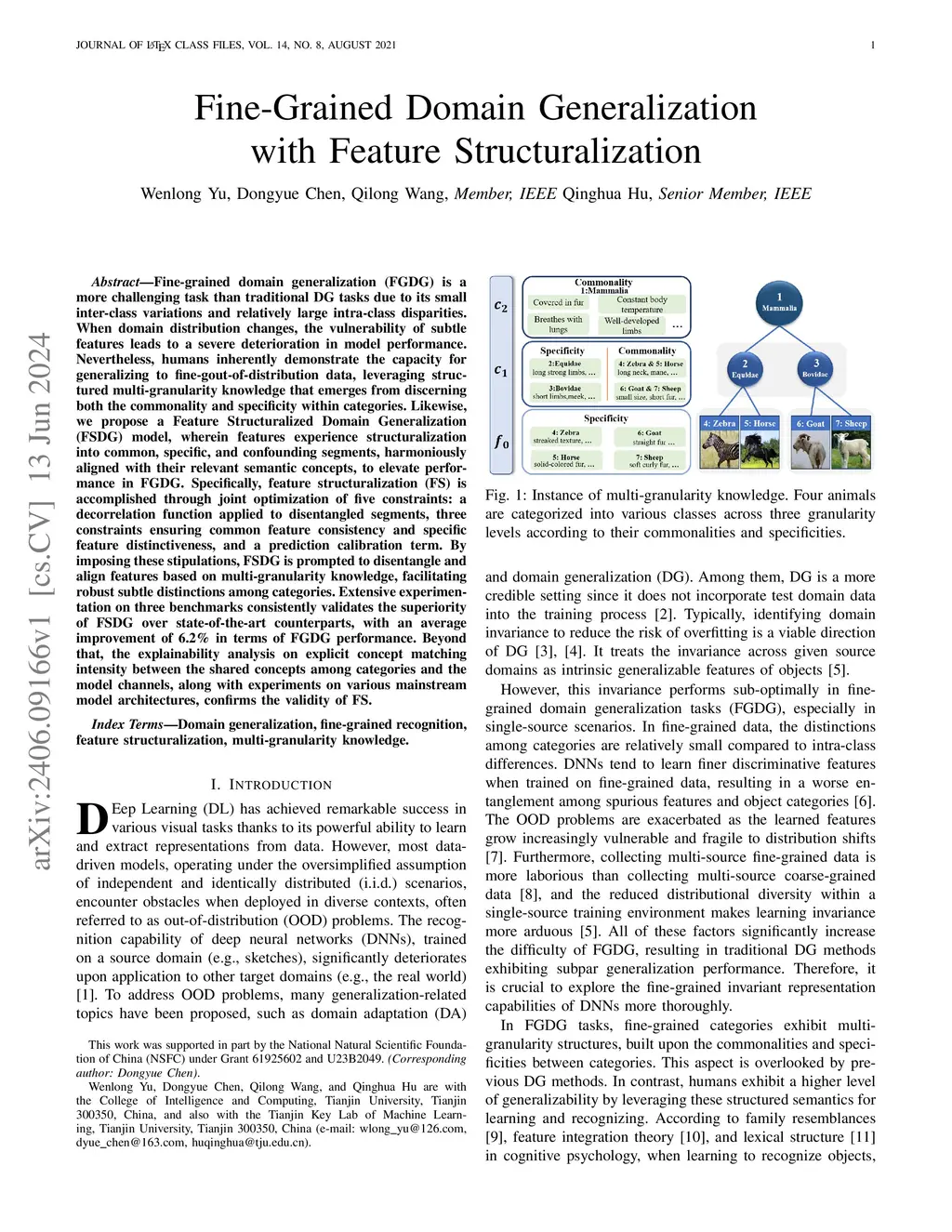
Fine-grained domain generalization (FGDG) is a more challenging task due to its small inter-class variations and relatively large intra-class disparities. When domain distribution changes, the fragility of subtle features leads to a pronounced deterioration in model this http URL, humans inherently demonstrate the capacity for generalizing to out-of-distribution data, leveraging structured multi-granularity knowledge that emerges from discerning both the commonality and specificity within this http URL, we propose a Feature Structuralized Domain Generalization (FSDG) model, wherein features experience structuralization into common, specific, and confounding segments, harmoniously aligned with their relevant semantic concepts, to elevate performance in FGDG. Specifically, feature structuralization (FS) is achieved through a decorrelation function on disentangled segments, constraints on common feature consistency, specific feature distinctiveness, and a prediction calibration operation across granularities. By imposing these stipulations, FSDG is prompted to disentangle and align features based on multi-granularity knowledge, facilitating robust subtle distinctions among categories. Extensive experimentation on three benchmarks consistently validates the superiority of FSDG over state-of-the-art counterparts, with an average improvement of 6.1% in terms of FGDG performance. Beyond that, the explainability analysis and experiments on various mainstream model architectures confirm the validity of FS.
View on arXiv