
Nexus sine qua non: Essentially Connected Networks for Traffic
Forecasting
- AI4TS
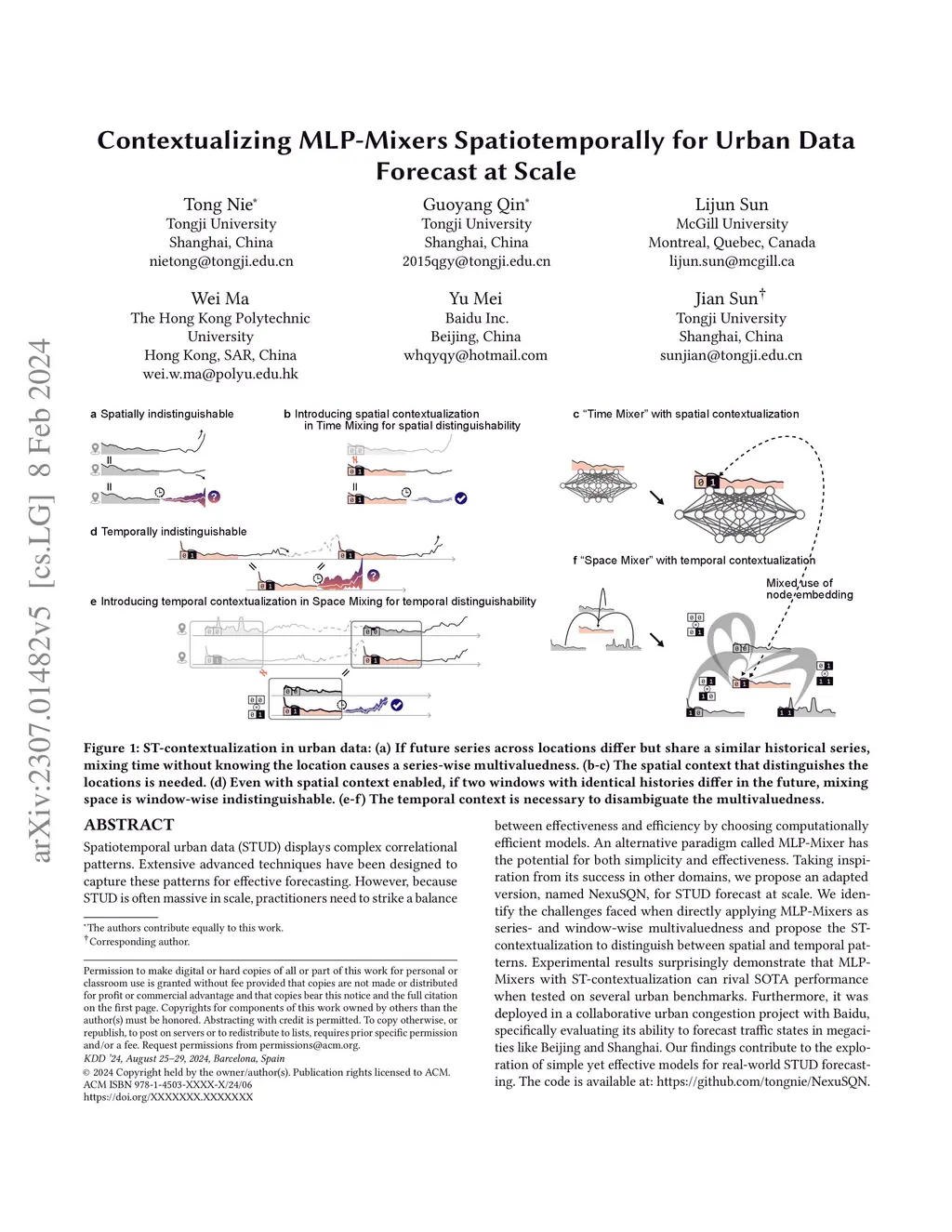
Spatiotemporal graph neural networks (STGNNs) have emerged as a leading approach for learning representations and forecasting on traffic datasets with underlying topological and correlational structures. However, current STGNNs use intricate techniques with high complexities to capture these structures, making them difficult to understand and scale. The existence of simple yet efficient architectures remains an open question. Upon closer examination, we find what lies at the core of STGNN's representations are certain forms of spatiotemporal contextualization. In light of this, we design Nexus sine qua non (NexuSQN), an essentially connected network built on an efficient message-passing backbone. NexuSQN simply uses learnable "where" and "when" locators for the aforementioned contextualization and omits any intricate components such as RNNs, Transformers, and diffusion convolutions. Results show that NexuSQN outperforms intricately designed benchmarks in terms of size, computational efficiency, and accuracy. This suggests a promising future for developing simple yet efficient neural predictors.
View on arXiv