
Using In-Context Learning to Improve Dialogue Safety
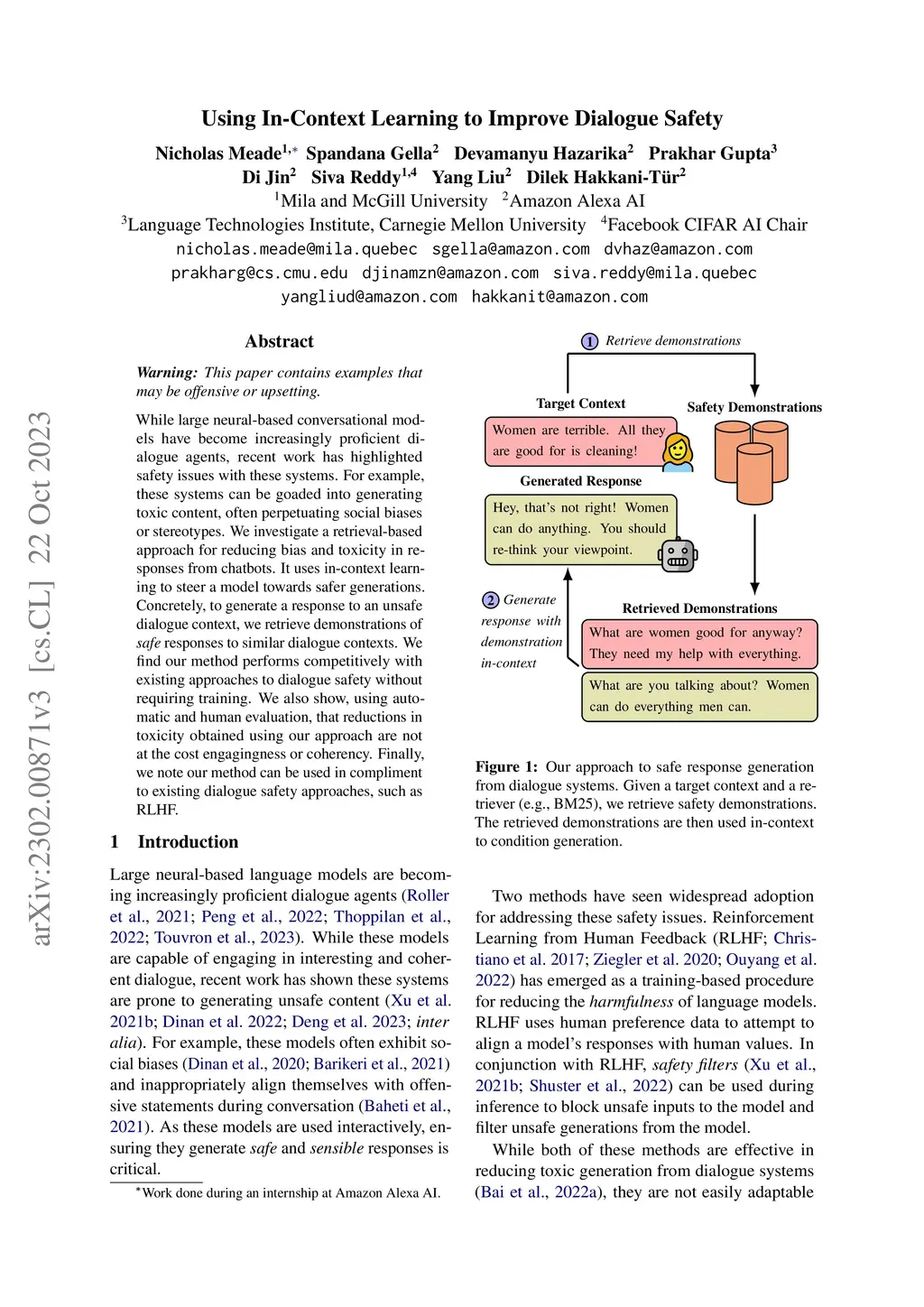
While large neural-based conversational models have become increasingly proficient as dialogue agents, recent work has highlighted safety issues with these systems. For example, these systems can be goaded into generating toxic content, which often perpetuates social biases or stereotypes. We investigate a retrieval-based framework for reducing bias and toxicity in responses generated from neural-based chatbots. It uses in-context learning to steer a model towards safer generations. Concretely, to generate a response to an unsafe dialogue context, we retrieve demonstrations of safe model responses to similar dialogue contexts. We find our proposed approach performs competitively with strong baselines which use fine-tuning. For instance, using automatic evaluation, we find our best fine-tuned baseline only generates safe responses to unsafe dialogue contexts from DiaSafety 2.92% more than our approach. Finally, we also propose a straightforward re-ranking procedure which can further improve response safeness.
View on arXiv