
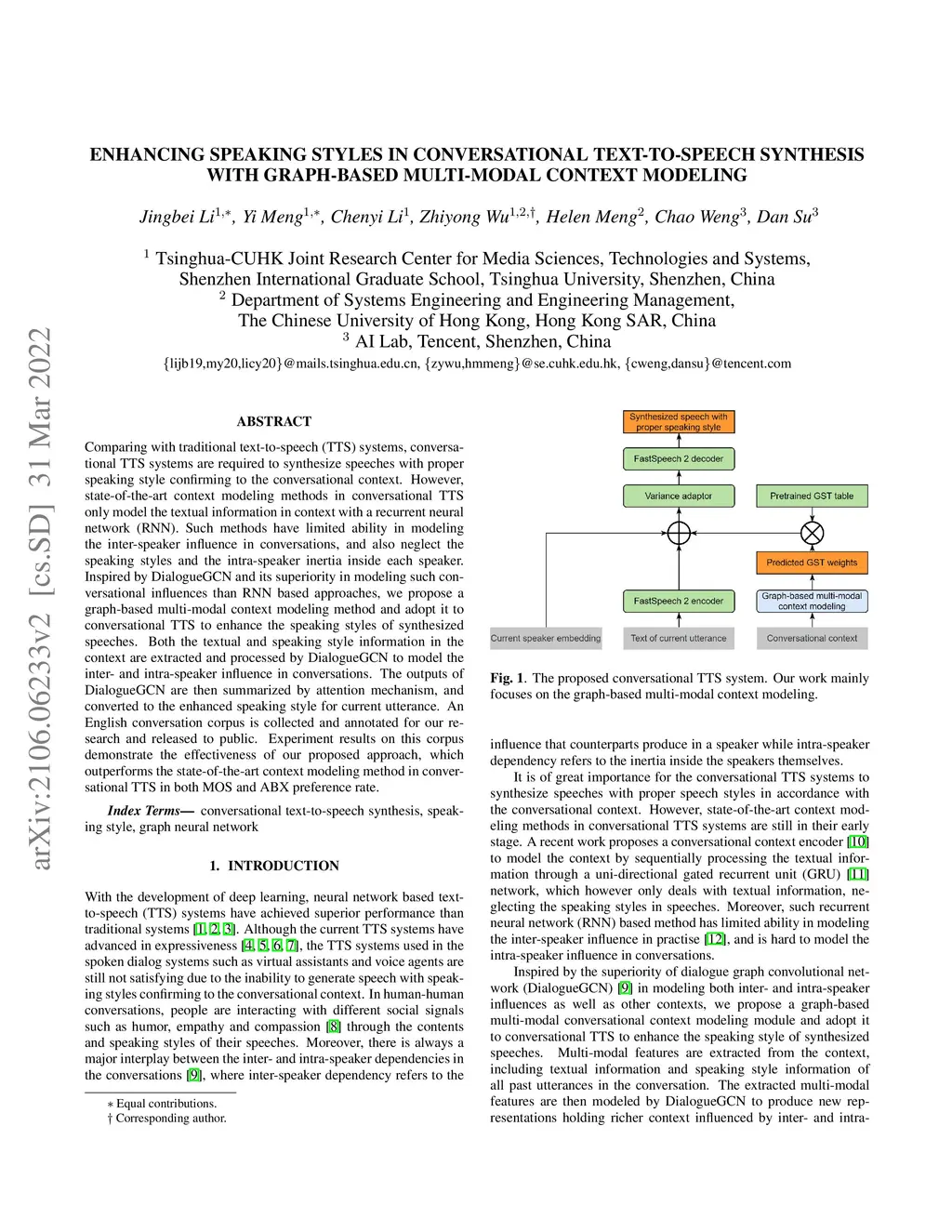
Comparing with traditional text-to-speech (TTS) systems, conversational TTS systems are required to synthesize speeches with proper speaking style confirming to the conversational context. However, state-of-the-art context modeling methods in conversational TTS only model the textual information in context with a recurrent neural network (RNN). Such methods have limited ability in modeling the inter-speaker influence in conversations, and also neglect the speaking styles and the intra-speaker inertia inside each speaker. Inspired by DialogueGCN and its superiority in modeling such conversational influences than RNN based approaches, we propose a graph-based multi-modal context modeling method and adopt it to conversational TTS to enhance the speaking styles of synthesized speeches. Both the textual and speaking style information in the context are extracted and processed by DialogueGCN to model the inter- and intra-speaker influence in conversations. The outputs of DialogueGCN are then summarized by attention mechanism, and converted to the enhanced speaking style for current utterance. An English conversation corpus is collected and annotated for our research and released to public. Experiment results on this corpus demonstrate the effectiveness of our proposed approach, which outperforms the state-of-the-art context modeling method in conversational TTS in both MOS and ABX preference rate.
View on arXiv