
Accelerated Gradient Tracking over Time-varying Graphs for Decentralized
Optimization
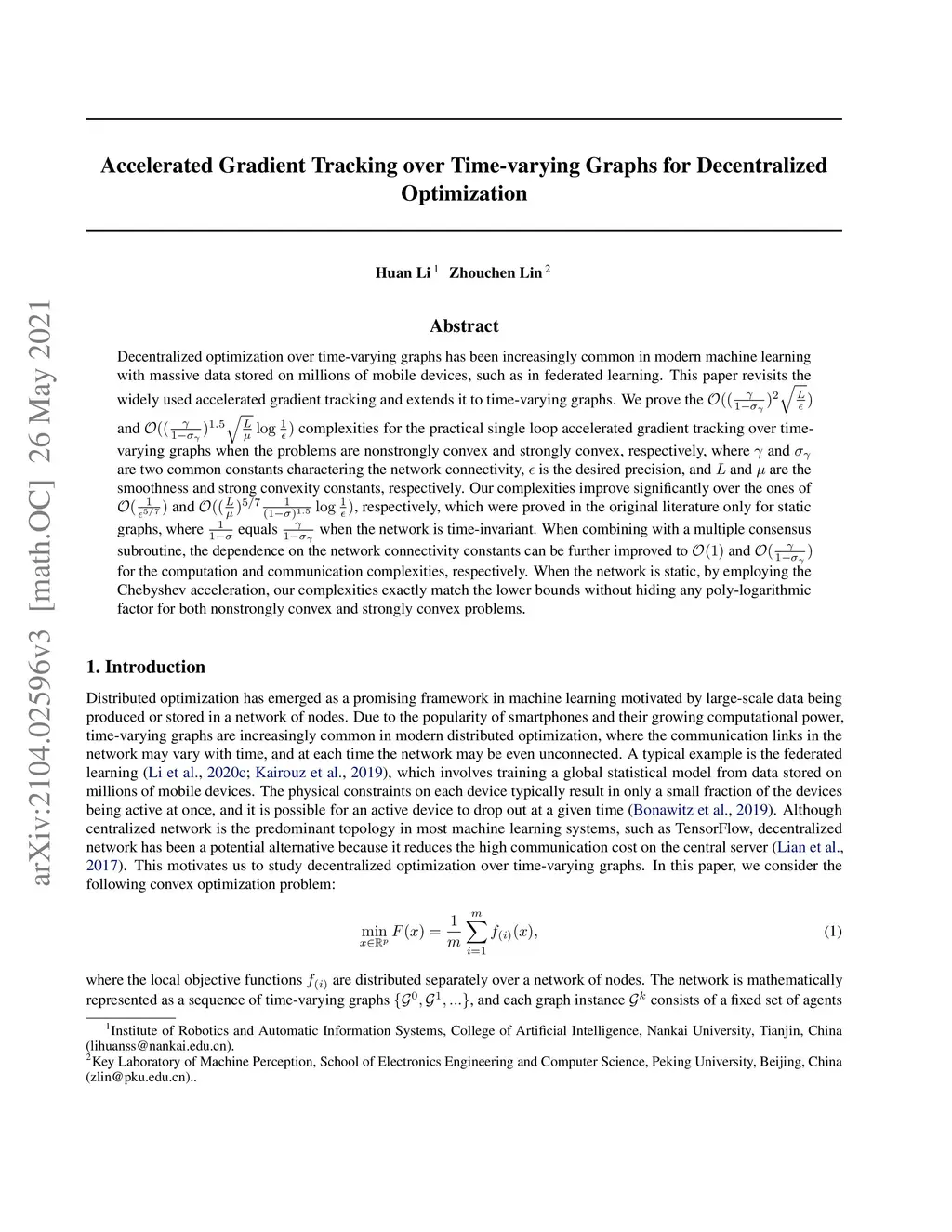
Decentralized optimization over time-varying graphs has been increasingly common in modern machine learning with massive data stored on millions of mobile devices, such as in federated learning. This paper revisits and extends the widely used accelerated gradient tracking. We prove the and complexities for the practical single loop accelerated gradient tracking over time-varying graphs when the problems are nonstrongly convex and strongly convex, respectively, where and are two common constants charactering the network connectivity, is the desired precision, and and are the smoothness and strong convexity constants, respectively. Our complexities improve significantly on the ones of and proved in the original literature only for static graph. When combining with a multiple consensus subroutine, the dependence on the network connectivity constants can be further improved. When the network is time-invariant, our complexities exactly match the lower bounds without hiding any poly-logarithmic factor for both nonstrongly convex and strongly convex problems.
View on arXiv