
Time-uniform central limit theory with applications to anytime-valid
causal inference
- CML
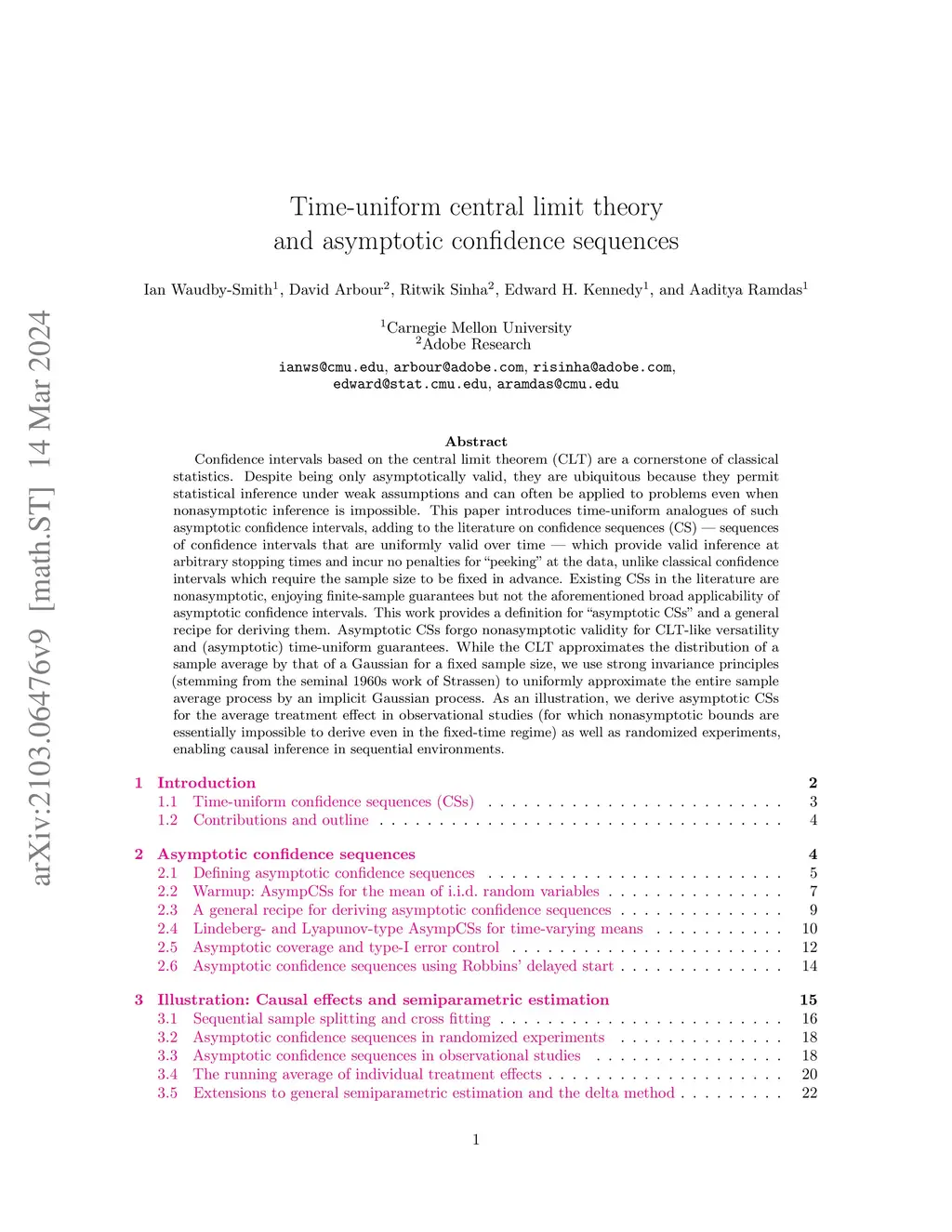
This work introduces time-uniform analogues of confidence intervals based on the central limit theorem (CLT). Our methods take the form of confidence sequences (CS) -- sequences of confidence intervals that are uniformly valid over time. CSs provide valid inference at arbitrary stopping times, incurring no penalties for "peeking" at the data, unlike classical confidence intervals which require the sample size to be fixed in advance. Existing CSs in the literature are nonasymptotic, requiring strong assumptions on the data, while the classical (fixed-time) CLT is ubiquitous due to the weak assumptions it imposes. Our work bridges the gap by introducing time-uniform CSs that only require CLT-like assumptions. While the CLT approximates the distribution of a sample average by that of a Gaussian at a fixed sample size, we use strong invariance principles like the seminal work of Koml\'os, Major, and Tusn\'ady to uniformly approximate the entire sample average process by an implicit Brownian motion. Applying Robbins' normal mixture martingale method to this Brownian motion then yields closed-form time-uniform boundaries. We combine these boundaries with doubly robust estimators to derive nonparametric CSs for the average treatment effect (and other causal estimands). These allow randomized experiments and observational studies to be continuously monitored and adaptively stopped, all while controlling the type-I error.
View on arXiv