
Bayesian Meta-Learning for Few-Shot Policy Adaptation Across Robotic
Platforms
- BDL
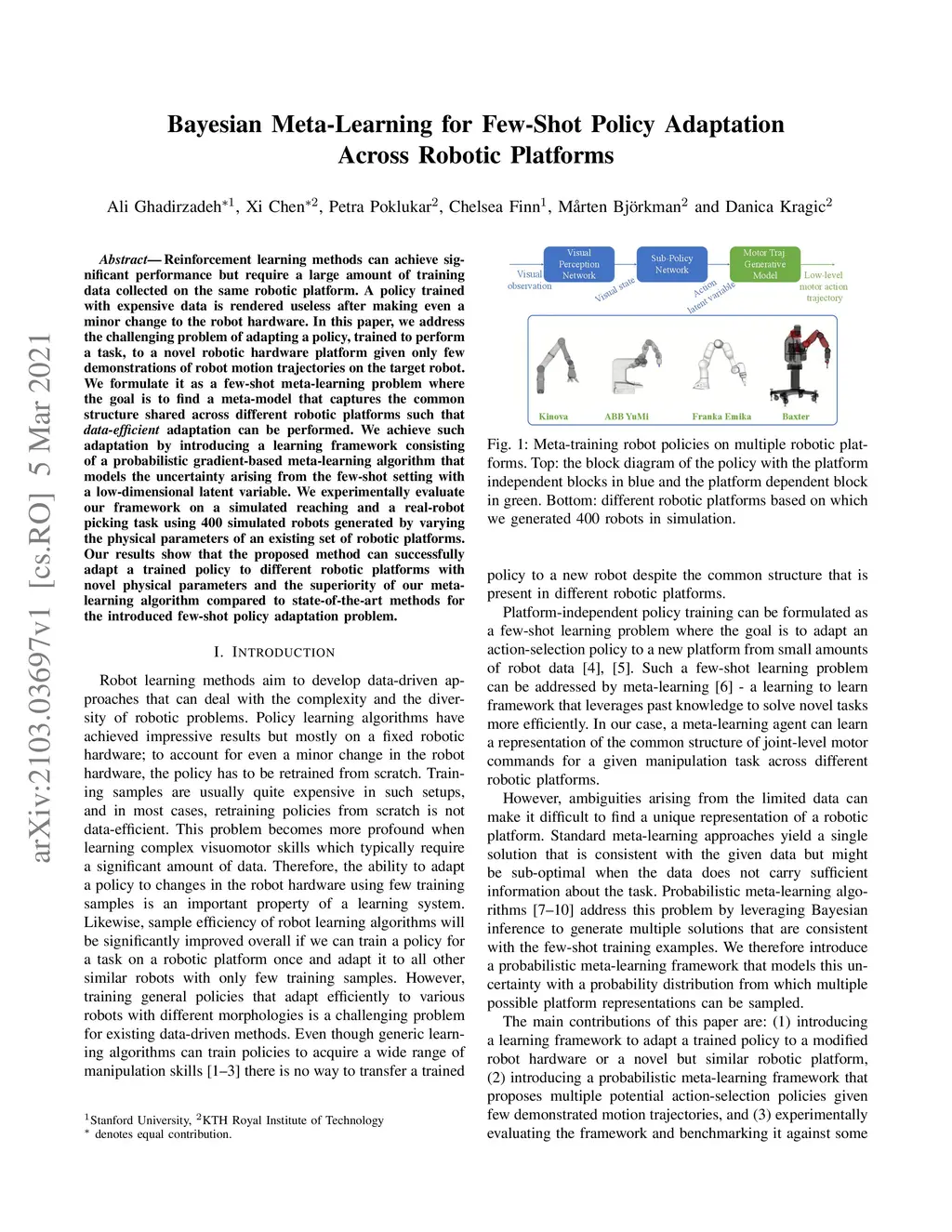
Reinforcement learning methods can achieve significant performance but require a large amount of training data collected on the same robotic platform. A policy trained with expensive data is rendered useless after making even a minor change to the robot hardware. In this paper, we address the challenging problem of adapting a policy, trained to perform a task, to a novel robotic hardware platform given only few demonstrations of robot motion trajectories on the target robot. We formulate it as a few-shot meta-learning problem where the goal is to find a meta-model that captures the common structure shared across different robotic platforms such that data-efficient adaptation can be performed. We achieve such adaptation by introducing a learning framework consisting of a probabilistic gradient-based meta-learning algorithm that models the uncertainty arising from the few-shot setting with a low-dimensional latent variable. We experimentally evaluate our framework on a simulated reaching and a real-robot picking task using 400 simulated robots generated by varying the physical parameters of an existing set of robotic platforms. Our results show that the proposed method can successfully adapt a trained policy to different robotic platforms with novel physical parameters and the superiority of our meta-learning algorithm compared to state-of-the-art methods for the introduced few-shot policy adaptation problem.
View on arXiv