
Hiding Among the Clones: A Simple and Nearly Optimal Analysis of Privacy
Amplification by Shuffling
- FedML
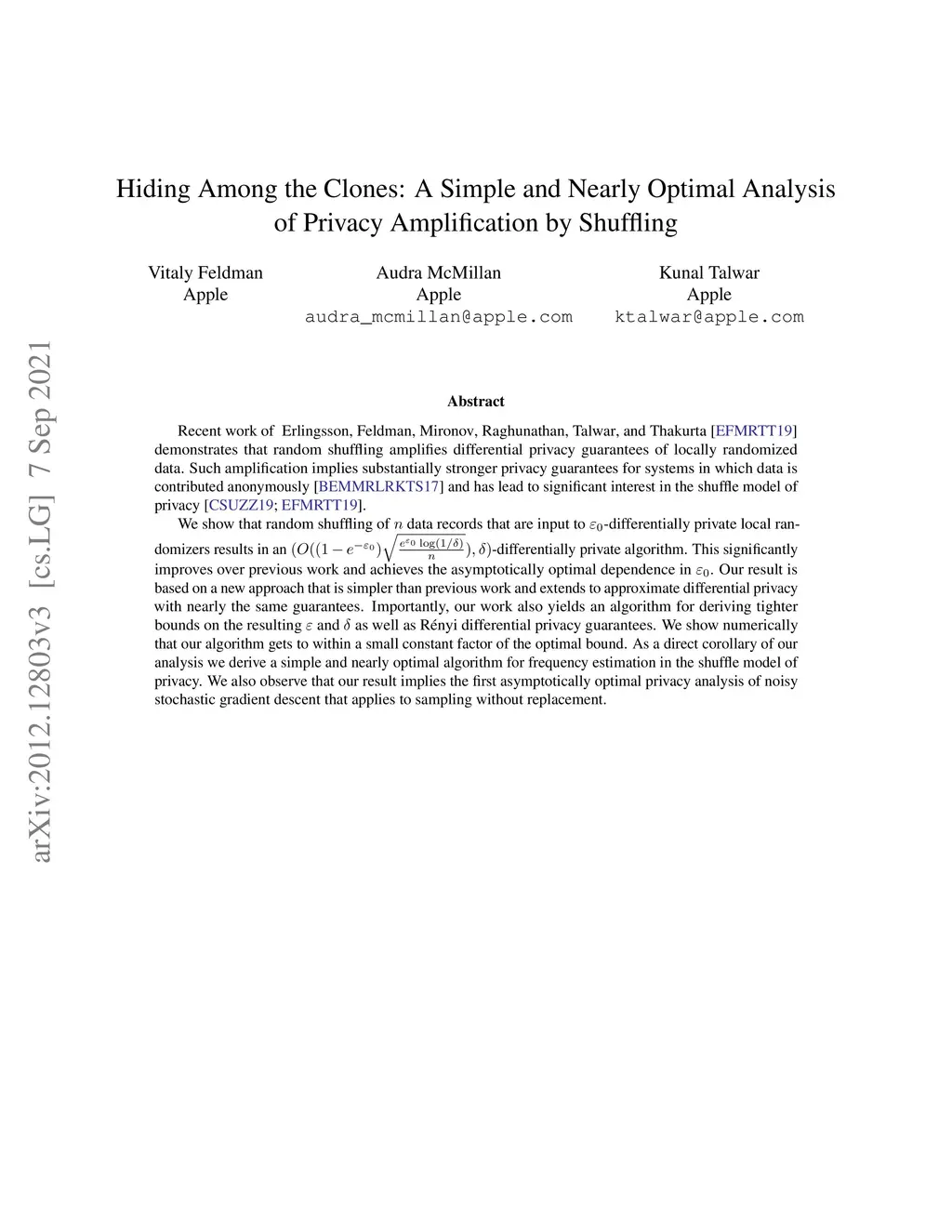
Recent work of Erlingsson, Feldman, Mironov, Raghunathan, Talwar, and Thakurta [EFMRTT19] demonstrates that random shuffling amplifies differential privacy guarantees of locally randomized data. Such amplification implies substantially stronger privacy guarantees for systems in which data is contributed anonymously [BEMMRLRKTS17] and has lead to significant interest in the shuffle model of privacy [CSUZZ19,EFMRTT19]. We show that random shuffling of data records that are input to -differentially private local randomizers results in an -differentially private algorithm. This significantly improves over previous work and achieves the asymptotically optimal dependence in . Our result is based on a new approach that is simpler than previous work and extends to approximate differential privacy with nearly the same guarantees. Our work also yields an empirical method to derive tighter bounds the resulting and we show that it gets to within a small constant factor of the optimal bound. As a direct corollary of our analysis, we derive a simple and asymptotically optimal algorithm for discrete distribution estimation in the shuffle model of privacy. We also observe that our result implies the first asymptotically optimal privacy analysis of noisy stochastic gradient descent that applies to sampling without replacement.
View on arXiv