
New Nearly-Optimal Coreset for Kernel Density Estimation
International Symposium on Computational Geometry (SoCG), 2020
Abstract
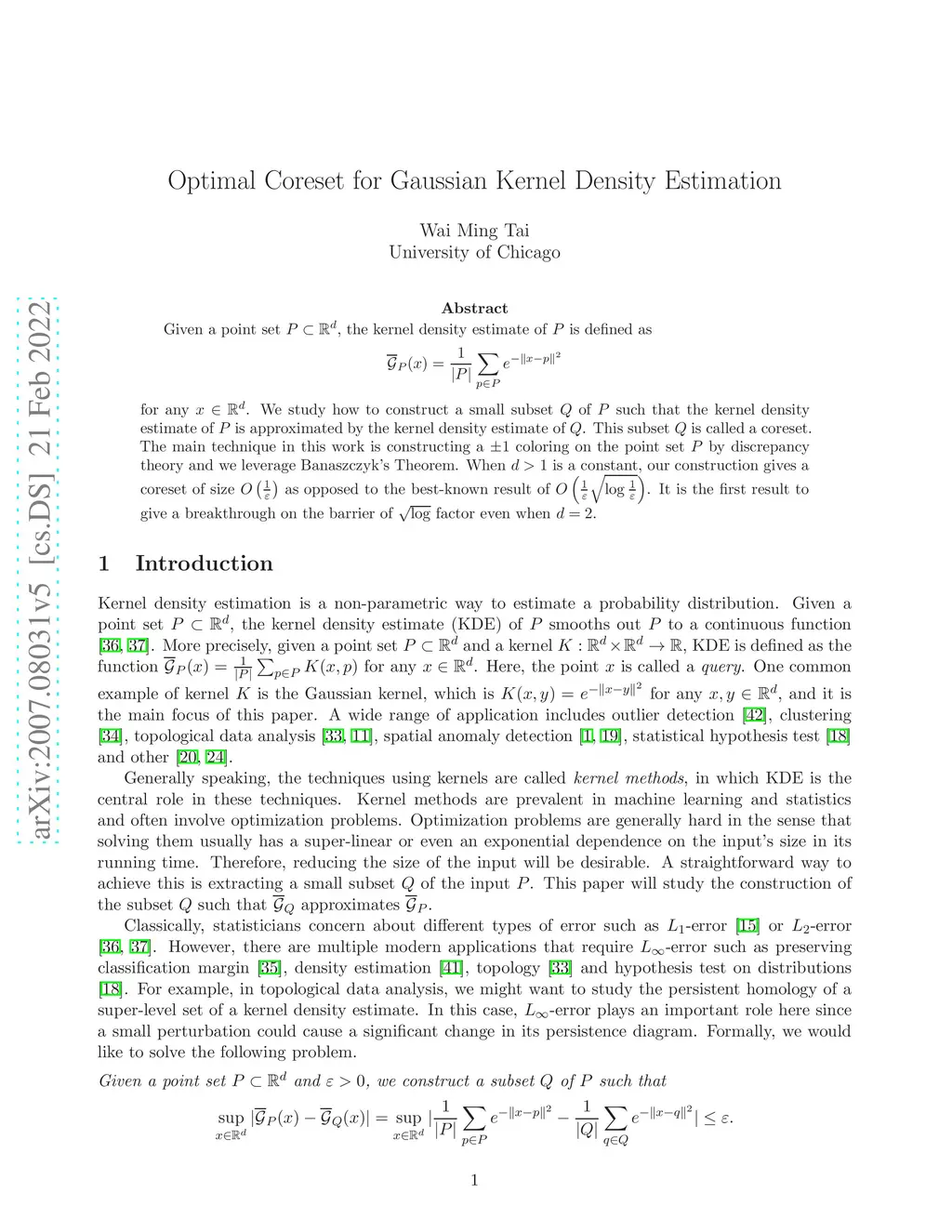
Given a point set , kernel density estimation for Gaussian kernel is defined as for any . We study how to construct a small subset of such that the kernel density estimation of can be approximated by the kernel density estimation of . This subset is called \emph{coreset}. The primary technique in this work is to construct coloring on the point set by the discrepancy theory and apply this coloring algorithm recursively. Our result leverages Banaszczyk's Theorem. When is constant, our construction gives a coreset of size as opposed to the best-known result of . It is the first to give a breakthrough on the barrier of factor even when .
View on arXivComments on this paper