
Pasadena: Perceptually Aware and Stealthy Adversarial Denoise Attack
- AAML
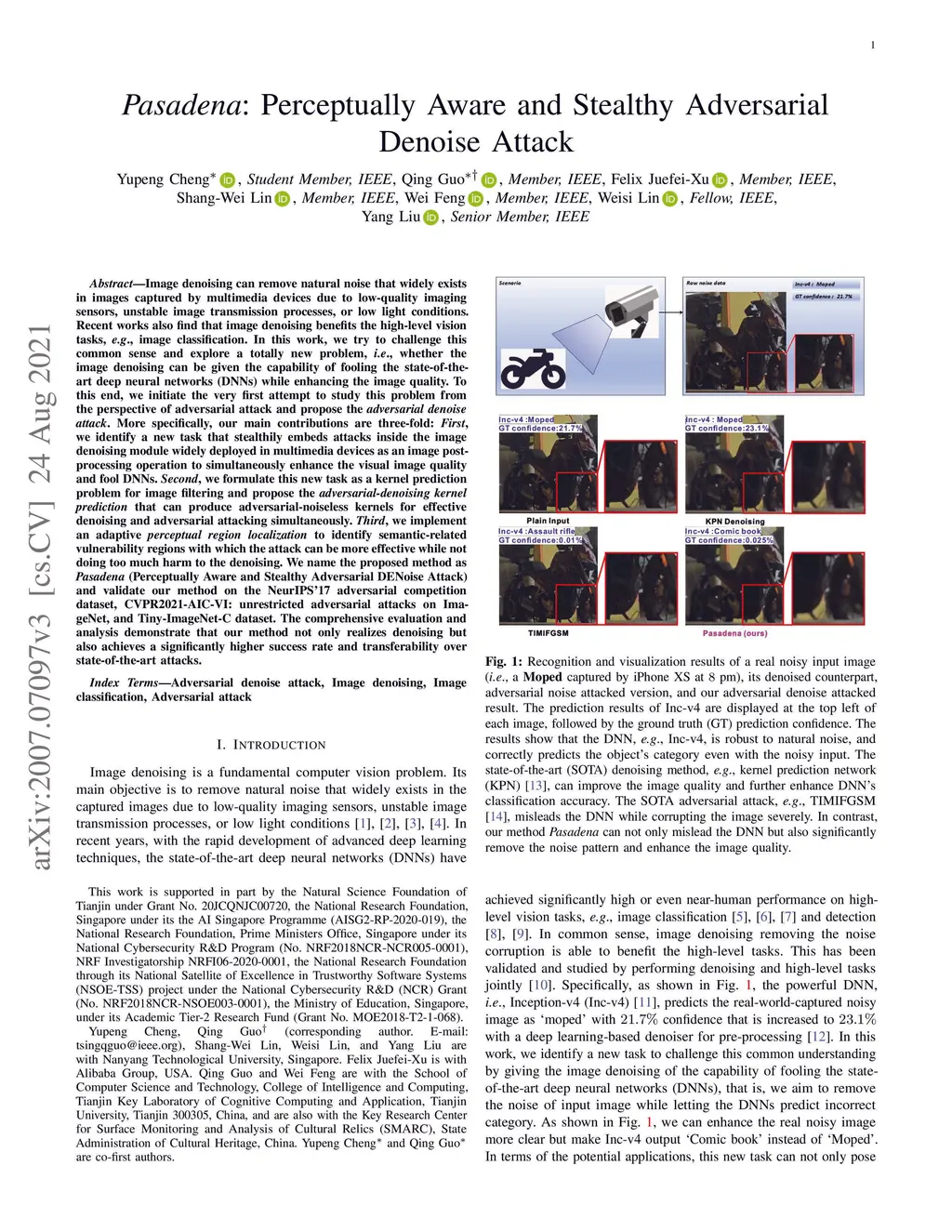
Deep neural networks (DNNs) have achieved high accuracy on various tasks and are even robust to natural noise that widely exists in captured images due to low quality imaging sensors, etc. However, the high performance DNNs also raise inevitable security problems, e.g., automatically recognizing a high-profile person's face and switching with a maliciously generated fake one to influence the outcomes of various critical events. This fact posts an important and practical problem, i.e., how to generate visually clean images while letting them have the capability of misleading the state-of-the-art DNNs to avoid potential security issues. In this paper, we initiate the very first attempt to address this very new problem from the perspective of adversarial attack and propose the adversarial denoise attack aiming to simultaneously denoise input images while fooling DNNs. More specifically, our main contributions are three-fold: First, we identify a totally new task that stealthily embeds attacks inside image denoising module widely deployed in multimedia devices as an image post-processing operation to simultaneously enhance the visual image quality and fool DNNs. Second, we formulate this new task as a kernel prediction problem for image filtering and propose the adversarial-denoising kernel prediction that can produce adversarial-noiseless kernels for effective denoising and adversarial attacking simultaneously. Third, we implement an adaptive perceptual region localization to identify semantic-related vulnerability regions with which the attack can be more effective while not doing too much harm to the denoising. We validate our method on the NeurIPS'17 adversarial competition dataset. The comprehensive evaluation and analysis demonstrate that our method not only realizes denoising but also achieves higher success rate and transferability over the state-of-the-art attacks.
View on arXiv